Initiated in July 2006 to provide piped water supply and sanitation facilities to remote and inaccessible tribal villages of Ganjam and Gajapati district villages covering a total of 550 Households.

Narrative
The project was initiated in July 2006 to provide piped water supply and sanitation facilities as well as indoor lighting to families using solar power. The project is being implemented in several remote and inaccessible tribal villages of Ganjam and Gajapati district villages covering a total of 500+ households. The inhabitants in the operational areas belong almost exclusively to the tribal population or ‘scheduled tribes’.
Taking Water and sanitation as an entry point intervention in this project, efforts are made to address the problems faced by tribal community living in remote areas where infrastructure development has been minimal. Provision of piped water supply to homes relieve women from the drudgery of walking miles to collect water, thereby gaining time to engage themselves in social and other productive activities. The regular use of toilets and bathing rooms and getting protected piped water has a bearing on their expenditure on medicines at the household level and radically improves the health status of the community. Finally, the water supply and sanitary infrastructure that is established becomes a symbol of collective as well as individual pride in the village. Through this programme, Gram Vikas attempts to bridge the gap that exist in the present scheme and demonstrate, how way for socially inclusive, gender equitable, people friendly and financially viable model of sustainable and holistic development.
- Impact Assessment (M&E) Phase Project completed on 7 Dec, 2010 Implementation Phase
-
Christine SamuelImplementation Status: completed Sun 20 Sep 2009, Over 16 Years ago
Ankuli Case Study
A journey from darkness to light: the story of Ankuli.
The village Ankuli has all the signs of development setting in –the solar panels, clean roads, kitchen gardens, toilets and bathrooms, the water tank, people with smiles on their faces, healthy children- that one can notice at first glance. They have successfully implemented the MANTRA (Movement and Action Network for Transformation of Rural Areas) programme of Gram Vikas. Since 2007 all the households in the village have 24-hour piped water supply to their homes along with toilets and bathrooms.
What makes Ankuli unique? This tribal habitation with 25 households having a population of 139 is situated 5000 ft above the sea level and 40km away from Patrapur block in Ganjam district, Orissa. It takes nearly 4 hours on foot to reach Ankuli from Tumba, where Gram Vikas project office is located. One has to walk through a narrow and nearly non-existential hilly road.
The project on solar powered water supply and sanitation system was initiated in the year 2007 with the support of the villagers, Gram Vikas and KKS, Germany.
The village is surrounded by beautiful hills on all sides. But the inaccessibility and difficult terrain has been an impediment in the path of the development for the people of Ankuli. Survival in the village has been quite difficult because of the difficult terrain coupled with absence of services delivered by government or any other agency nearby. Even for domestic chores like fetching water or gathering fuel wood, the people had to trek miles downhill. In the summer months the drudgery of fetching water becomes all the more acute especially for the women. This had other fallouts on the health condition of the people. Skin and other water born diseases were rampant due to unhygienic condition and lack of protected water. The prevalence of Malaria was high. Medical facility is out of reach for them and government health workers never visit to the village.
The people of Ankuli mainly practise and depend on bogodo (slash and burn cultivation) for their livelihood where they mainly grow jana, kangu, mandia, and suan (food grains). They also collect timber and other forest produces from the jungle nearby.
Education facilities have been dysfunctional too. There is a government primary school in the village but the teacher rarely comes. In this context Gram Vikas had initiated work in Ankuli in the early 90’s taking education as an entry point activity and starting a day school in the village. Gradually the focus spread to other areas of development intervention like health, savings, land development and housing infrastructure. Horticulture was promoted among the tribals to check deforestation and reduce their dependency on bogodo cultivation. Gradually their dependencies on bogodo reduced and they started cultivating rice, vegetables and fruits.
The solar powered water supply and sanitation programme was initiated in response to the poor health conditions of children and adults due to lack of clean water and improper human waste disposal systems. In 2006 Gram Vikas in collaboration with KKS, Germany took up a project to provide individual toilets and bathing rooms with piped water to individual households.
Initially through a series of meetings, villagers were motivated to agree in principle to the terms and conditions of the programme. But there were many hindrances on the way of successful implementation of the project. The problem of making bricks, availability of sand and transportation of other construction materials, solar panels, pump set, HDP water tank etc. from ground to the village was tough for the beneficiaries. In addition to this people had to also contribute Rs. 1000 towards the village corpus fund, the interest of which is supposed to meet the cost of the external materials for the construction of toilets and bathing rooms to new households that come up after the project has been completed.
In 2007,amidst difficulties, people completed construction of toilets and bathing rooms. Technicians helped the people in fitting the solar panels, pumps and other equipments for water supply. The day people got piped water supply in their homes, they forgot the pain they had taken during the execution of the project. Besides toilets and bathing rooms, every household has been electrified using solar power. Because of the solar light the school going children now can study in the evenings. Solar power has helped a lot to the women members in SHG groups of the village. They now come together to have their meetings in the evening and can also utilize the light for some income yielding activities. The women members have also planned to install a rice huller that can run on the extra power generated by the solar system.
The people of this small tribal village now seem happy. When they recall their gloomy past they say it was beyond their imagination that one day they would see piped water and light in their homes. The nearby villagers eagerly come to see this village and want the same facilities in their villages. The sheer determination and hard work of the people of Ankuli did not go in vain and became an inspiring factor for others to follow.
-
Satyadeep Pati of Gram VikasImplementation Status: in_progress Thu 17 Sep 2009, Over 16 Years ago
Project granted one year extension
Technical issues on water supply prevented completing project. So water will need to be supplied through gravity flow and to create that system, a one year extension was given by the funder.
-
Chitra Chaudhuri of Gram VikasImplementation Status: completed Wed 31 Dec 2008, Over 17 Years ago
Dec. '08 Progress Report
This Annual Progress report, for the period January to December 2008 of the project ‘Water and Sanitation with Solar Power Supply for Remote Tribal Communities’, funded by KKS, describes and highlights the operations made by Gram Vikas in the project areas.
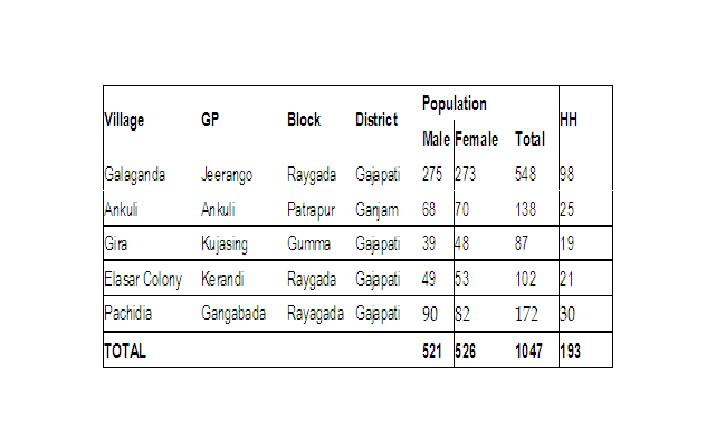
The project has been initiated in July 2006 to provide piped water supply and sanitation facilities as well as indoor lighting to families using solar power. The project is being implemented in 5 remote and inaccessible tribal villages of Ganjam and Gajapati district villages covering a total of 200 families. The inhabitants in the operational areas belong almost exclusively to the tribal population or ‘scheduled tribes’.
This project intends to ensure 100% water and sanitation with solar power supply to the five remote and inaccessible tribal habitations of Ganjam and Gajapati district, covering 200 households. Till the third quarter of 2008 (July-Sept), the total no of households supported with the project were 193, but in Pachidia, 7 more households have shown interest to be included in the programme. We would like to propose to KKS to allow for the seven families to be included in the project under the same terms and conditions. Gram Vikas would make allocations for the subsidy from the current budget allocation. (In the quarterly report of Oct –Dec 08, due to calculation error the number of total population was incorrectly reported as 1190 as against 1047).
During the reporting period people in Galganda and Pachidia have collected local materials required for construction of TBRs like sand, stone, and other aggregates.
.
In Galganda construction of 98 Toilets/bathing rooms have been completed in all respects.In Pachidia till the end of December 2008, brickwork has been completed for 35 TBRs.
Presently three villages are getting piped water supply to individual homes.
Water supply started in Ankuli and Elasar colony in 2007 and in Gira in 2008. In Gira, pumping is taking place for 6hrs/day from an open dug well to an overhead HDP water tank of 5000 litres capacity. People in Gira have decided to use the existing well for water supply. The platform work of the well has also been completed.
Solar panels and pump sets have been procured and installed at Gira. The expenditures for the procurement of control apparatus, line distribution and lighting for Ankuli and Elasar colony was booked in January 2008. - Procurement for Gira in the third quarter of 2008. The lighting system is functional in Gira. Each household has been provided with two CFL bulbs.
All the five village committees have now acquired legal status. In 2008, the committees at Galganda, Pachidia and Elasar colony were registered.
An exposure trip was organized for the SHGs in the Tumba project (in which 3 female members from Ankuli participated) to Ranpur (where some SHGs are supported by Basix, Hyderabad which mainly works on Micro Finance) to understand the income generation activities (IGA) like leaf plate making, vegetable cultivation and other agricultural activities taken up by these groups.
During this year training and awareness programmes were conducted in operational villages covering a wide range of issues like sanitation and hygiene, Panchayati Raj, financial management for SHGs, skill building training like masonry and plumbing, Forest Right Act 2006, etc were conducted .
In Gira village, members from the village committee were trained in handling the solar pumping system operations and the maintenance mechanisms
The agreement papers between the beneficiaries and Gram Vikas have been signed in all the five villages, stating ownership of land and with people agreeing not to sell the land/toilet-bathing room for the next ten years.Corpus collection is completed in the villages of Ankuli, Gira and Elasar colony. Collection is ongoing at Galganda and Pachidia.
Regular collection of maintenance fund is there in Ankuli, Gira and Elasar colony for the water supply system. No major maintenance issues were faced in the period.More than 150 women of 13 Self-help groups are actively involved in savings, credit, income generation and other livelihood promotion activities.
During 2008 the Maa Mangala and Vikas group in Galganda have received external loans. Maa Mangala group has received Rs.2, 00,000 as external loan and have invested the money in goatery and light and sound business. The other group, Vikas group, has received Rs 20,000 from B-mass linkage. One group in Ankuli (Bijayalaxmi Group) has also received external loan of Rs14, 000.
To expand their income generating activities both the groups of Elasar colony have decided to purchase leaf plate making machine. One training on masonry started in December 2007 continued till Feb 2008 with 19 participants at Galganda.
Another mason training at Pachidia with 11 participants were conducted. The trainees have assisted the families in Pachidia and Galganda in the construction of toilets and bathing rooms.
Two training programmes were organized on Plumbing at Galganda (September 08) and at Pachidia (November 08), one stone cutting training also at Pachidia in the month of January 2008. -
Chitra Chaudhuri of Gram VikasImplementation Status: completed Sat 20 Dec 2008, Over 17 Years ago
Case Study - Gira
Orissa Solar Water Pumping Project
Bringing drinkable water, light, and sanitation
to the people of Gira (Orissa)
Location
Gira, Gajapati district, Orissa, IndiaSystem Installation
June 2008Number of beneficiaries
19 households
91 inhabitantsCapacity of Installed Photovoltaic System
1350 WSystem Specifications
Well depth: 60m
Dynamic Head: 70m
Flow Rate: 3000 L/h
Volume of the Water Tank: 5000 L
Water consummation per day: 4000 L
Grundfos SQF 3A-10 pump:
18 panels of 75 W eachCost of the Project
Sanitation program
76,000 Rs
SWP program
908,288 RsA tribal village in Gajapati, Orissa is now supplied with drinkable water and electricity. Gira, the village, is located on the top of a mountain (Devagiri range of hills in Gajapati), hard to reach (960 m above sea level), and had neither a water spring close to the village nor electricity. Previously, the 91 villagers had to carry approximately 40 L of water per inhabitant each day from a stream several kilometers away, and the water was not even clean. In addition, villagers were using kerosene lamps to light their houses that produced unhealthy smoke. Now, thanks to the Solar Water Pumping System installed by Gram Vikas, villagers are supplied with drinkable water and electricity.
How this technology benefits to rural tribal
This system does not only bring water and electricity, it also allows the construction of sanitation facilities and brings more dignity in the life of villagers. Since water has become available, Gram Vikas has built a toilet and bathroom for each household. It also enables the villagers to save time and to benefit from a 24h water supply. Moreover, instead of using kerosene lamps (which are polluting and expensive), they now enjoy a sufficient and green lighting.
Villagers were so happy when the system was installed one month ago that they blessed it during a ceremony with tribal rituals. “Now that water is easy to get, we have more time to work in fields and we are more productive,” villagers said. When we asked them if the system performance was satisfying, they all answered in one voice, “bangsa,” which means “OK, perfect” in Saura, their tribal oral language.
Why use a Solar Water Pump?
For the tribal villages of Orissa it is sometimes hard to have access to clean and drinkable water, especially now when groundwater is unsafe. Water must be drawn from deep in the ground, which requires pumping water that is deep underground. But in many tribal villages in Orissa, there is no electricity. Either the village is too far from the national grid or villagers are too poor to pay for the electricity. A solar photovoltaic system seems to be the best solution to ensure electricity for the pumps. The Solar Pumping System improves the life conditions of the tribal people of Orissa. It provides clean water and electricity, allows for the building of sanitation systems and decreases the risk of diseases due to contaminated water. This kind of project costs an average of 10,000Rs per inhabitants. This Solar Pumping System is a big step for the improvement of tribal life.
Mechanisms for Sustainability
Social sustainability – Gram Vikas does not only install the system in Gira. Gram Vikas also involves villagers as much as possible in the construction of the system. Villagers value this new technology more because of their investment and because they understand how it works. This is the path to total autonomy for villagers, which is the aim of all Gram Vikas’ projects. Some villagers have been trained to operate the system and the village committee collects every month a small tariff of 60 Rupees (1€) for a reserve fund for each household to maintain the system. There is also a corpus that has been created in which every family contributes an average of 1,000Rs in order to help new families that settle in the village to build their own sanitation facilities. In the end, villagers will be able to understand, operate, maintain and fix the system autonomously in order to make it sustainable.
Financial sustainability - The system has been provided and is maintained by AURORE based in Tamil Nadu. The Karl Kubel Stiftung Foundation has funded the sanitation program. 200 Rs were paid by each household to buy the bulbs.
Technical sustainability - The Water Pumping System needs electricity. This electricity is provided by solar photovoltaic panels, which convert sunlight into electricity. This system produces green electricity and ensures the full energy independence of the site. This system is fully efficient during the peak-sun hours of the day. A battery bank stores electricity for the lights used during the night.
When the tank is not full and there is water in the well and enough sun to provide electricity, the pumps are switched on by a villager. Water is pumped from the bottom of the well to the top of the water tank.
Water is then stored in the water tank, which is usually set in a place higher than the village households. Water is distributed and available for villagers. Thanks to gravity, water is brought through pipes from the tank to the water points without using electricity. The tank stores the pumped water and can supply water even when there is not enough sunlight.
This project was supported by Aurore, KKS Benshiem, and Gram Vikas.The project is located in Gira, Gajapati (Orissa)
-
 case_stu...
-
-
Chitra Chaudhuri of Gram VikasImplementation Status: completed Sat 20 Dec 2008, Over 17 Years ago
Case Study - Elasar Colony
ORISSA SOLAR WATER PUMPING PROJECT
Bringing water, sanitation and lighting to the people of Elasar Colony (Orissa)Location
Elasar Colony, Gajapati district, Orissa, IndiaSystem Installation
November 2007Number of beneficiaries
21 households
84 inhabitantsCapacity of Installed Photovoltaic System
1200WSystem Specifications
Dynamic head: 30m
Well depth: 20m
Flow rate: 7000L/day
Volume of water tank: 14,000L
Volume used by the village:
6000L/dayCost of the project
Sanitation program
100,800 Rs
SWP program
507,529 RsThe project was supported by KKS Benshiem, Gram Vikas, and Aurore.
84 inhabitants of a poor and remote village of Orissa now benefit from water and electricity thanks to a solar water pump. This village, Elasar Colony, is situated in the Gajapati district in south Orissa. One year ago, people (especially women and children) used to travel twice a day to a well located miles away from their village to collect water. In this village Gram Vikas carried out its first project combining solar pumping with lighting. Its success encouraged the implementation of this system in other villages in Orissa.
The villagers are happy with this system: “It’s a real pleasure. Before settling the Solar Water Pump it was dark. Now, we have light in the night.” Moreover, the pump enabled villagers and Gram Vikas to develop sanitation that reduced the number of diseases related to bad water quality. Today, every household has one bathroom and toilet. Villagers can use this water to bathe, to wash their clothes and to cook. Moreover, after being used, the water goes directly through pipes to house cultivations (where villagers cultivate vegetables and fruits for their own consumption).
Why Use a Solar Water Pump
For the tribal villages of Orissa it is sometimes hard to have access to clean and drinkable water, especially now when groundwater is unsafe. Water must be drawn from deep in the ground, which requires pumping. Electrical pumps allow access to cleaner water that is too deep underground to be accessible with manual pumps. But in many tribal villages in Orissa, there is no electricity. Either the village is too far from the national grid or villagers are too poor to pay for the electricity. A solar photovoltaic system seems to be the best solution to ensure electricity for the pumps. This kind of project costs an average of 6,000Rs per inhabitants.
How this technology benefits to rural tribal
The Solar Pumping System provides clean water and electricity, allows for the building of sanitation systems and decreases the risk of diseases due to contaminated water. It enables the villagers to save time and to benefit from a 24h water supply. Moreover, instead of using kerosene lamps (which are polluting and expensive), they now enjoy a sufficient and green lighting. This Solar Water Pump System is a big step for the improvement of tribal life.
Mechanisms for Sustainability
Technical sustainability - The Water Pumping System needs electricity. This electricity is provided by solar photovoltaic panels, which convert sunlight into electricity. This system produces green electricity and ensures the full energy independence of the site. This system is fully efficient during the peak-sun hours of the day. A battery bank stores electricity for the lights used a during the night.
The water is then stored in the water tank usually set in place higher than the village households. The water tank stores the pumped water and can supply water even when there is not enough sunlight. It can contain 14.000L (2 or 3 days of water for these 84 inhabitants).
Thanks to gravity, water is brought through pipes from the water tank to the water points without using electricity. The water is distributed and available for the villagers. Then, the used water is lead to house-cultivations (behind toilet and bathroom).
Financial sustainability - The system has been provided and is maintained by AURORE based in Tamil Nadu. The Karl Kubel Stiftung Foundation has funded the sanitation as well as water supply program. The village committee organized village meetings to discuss the tariff paid by each household to create a fund for maintenance, the purchasing of materials to repair the system and possible upgrading. They agreed upon an amount of 50 rupees (1US$) per family per month. 200 Rs were paid by each household to buy the bulbs.
Social sustainability – More than just installing the system, Gram Vikas’ helps make the village independent. To do so, an operator from the village is trained in Gram Vikas’ facilities to use the system and gradually to be able to maintain the system and to repair it. To involve the community in the project, villagers help build their own sanitation facilities. There is also a corpus that has been created in which every family contributes an average of 1,000Rs in order to help new families that settle in the village to build their own sanitation facilities.
-
case_stu...
-
-
Chitra Chaudhuri of Gram VikasImplementation Status: completed Tue 01 Jan 2008, Over 18 Years ago
Progress Report - Dec '07
This report highlights the progress of the project - Water and Sanitation with Solar Power Supply for Remote Tribal Communities implemented by Gram Vikas, Orissa with support of KKS Foundation, Germany. The report illustrates the progress of the project for the period January- December 2007.Gram Vikas implements the project in five remote and inaccessible tribal villages of Ganjam and Gajapati district. The inhabitants of all five communities belong almost exclusively to the tribal population or ‘scheduled tribes’.
Supply of drinking water and sanitation
In two villages, namely Ankuli of Tumba project and Elsara Colony of Anandapur project, water supply has already been started. The water supply and sanitary infrastructure has already been completed at Gira but delivery of piped water is delayed due to some technical difficulties like finding the appropriate water source from where the water can be pumped using the solar pump. In the villages where the water supply has been functional, people have started using the toilets. At Pachidiha, people have started constructing toilets and bathing rooms.
It was decided in the month of December 07 that an additional 29 households that form a part of Galaganda village would be provided toilets and bathing rooms in addition to the already reported 69 villages for the same village.To make the water and sanitation infrastructure effective, a comprehensive health programme is followed in all the five project villages. All the families are being continuously motivated about the benefits of using clean water and following proper hygienic practices. Immunization of children and antenatal mothers, growth monitoring of children below 5, distribution of anti-malarial drugs, etc. is a part of promoting secure health in these villages. School teachers and children, SHG members, village development committee members and government officials are involved in the process of creating awareness and promoting good health in these villages. Gram Vikas works in association with the ASHA (Accredited Social Health Activist), government staff, in these villages for promoting safe delivery practices and better care for neo born babies.
Improved livelihood opportunity
Availability of water in the house has relieved women and girl children of the task of walking miles to fetch water. Children are able to attend schools and the increase in attendance is evident in the monthly records.
Besides water supply and sanitation, importance is given to enhance livelihood opportunities through the formation of self-help groups, imparting training on skill development activities like mason training, stone cutting training, using local resource judiciously and linking groups with financial institutions to help them avail institutional credit. In order to generate additional income women groups are encouraged to process available Non timber forest produce to make brooms, leave plates, resins, tamarind etc. The groups, which are engaged in livelihood generating activities, are making a profit of more than Rs 500 per month.
Through 12 self-help groups more than 100 women are involved in savings and credit and have taken up small-scale activities. During the period a total of five groups (two from Elsara and three from Galganda) have received external loans and have widened their income generating activities. The two groups in Elsara colony, which have received money from external sources, are engaged in collective marketing of tamarind, pearl millet and broom making. Two groups (one each in Galaganda and Ankuli) are involved in managing the Government’s Mid Day Meal (MDM) scheme for the school and thus make profit for the group. One group at Ankuli is exploring the idea to install a rice huller to widen income-earning opportunities.
These groups have also been able to demonstrate the benefits of SHGs to other women who are still not involved in self-help group activities. Due to the demonstration effect, a new self-help group, Padmavati self-help group, was formed at Pachidiha in the month of December 2007, consisting of 14 tribal women.
In all the project villages, strengthening of people’s organizations and the capacities of men and women to manage the ongoing community development initiatives are recognized as the core principle for sustainability of the programme. Establishing an institutional arrangement through formation of a village committee at the grass-root level enables the rural communities to manage their socio-economic and development affairs in the village and contributes in the process of promoting rural local governance. In each of the five target communities specific committees have been selected who are responsible for the supervision of the construction work and the subsequent operation and maintenance of the water supply. The committees also formulate norms on defecation behavior and anyone who is found to violate the rules after the construction and water supply work is completed, is penalized. They have devised mechanisms for the Operation and Maintenance Costs to run the water supply. Out of the total five committees, only two committees have been registered under the Societies Registration Act, 1860 in 2007. The delay in registration of other committees is due to government procedures and bureaucratic bottlenecks.
In the formation of the committee, attention is paid to equal representation of men and women to maintain gender and social equity. The committee involves almost equal number of men and women in its composition. In total there are 69 members of which females consist of 39 in number and the rest are male members. The committee meets at least once in a month and discusses issues pertaining to the implementation of the programme, management of natural resources and livelihood aspects. Slowly the participation of women in the decision making process has improved as they understand the benefit of attending the meetings. Issues related to government schemes like NREGS as well as other social security measures are also taken up for discussion.
Through continuous capacity building of the members of the Self-help groups, the women are more confident to access loans from external institutions and invest in activities that contribute to improved income. They have also successfully taken up the responsibility of the Mid day meal scheme and thus are able to monitor the attendance of the teachers as well as the students regularly.
Constraints Encountered:
The difficult geographical terrain imposed a major constraint for the staff as well as the people of the villages. The lack of roads made it very difficult for the communities to transport materials from the base to the village.Locating the water source at Gira has been a constraint because the distance from the existing source (dug well) to the village is quite high and that will entail additional solar panels to meet the head load. There is also danger of theft of the solar panels if they are not located in the village or close by from where people can guard them. We are trying to find an alternate water source that can be closer to the village.
Other positive or negative events of the project
In spite of the difficulties faced, the project brought many positive changes towards attaining and maintaining a dignified and sustainable quality of life. Social and economic cohesion among the villagers have increased a lot. Due to this social cohesion, people are aspiring for extending their economic activities from personal to community level like a women’s group is exploring the option of setting up of a rice huller. There is also the palpable sense of confidence in the people, that they have the power to make changes in their lives.One of the tangible benefits is the elimination of the drudgery of fetching water from distant places by the women. This has also led to women aspiring to go for economic activities as well as other activities that contribute to decreasing their workload. The installation of indoor lighting has been a boon for the people and this has led to increased socialization and meetings as well as time for reading, carrying out other chores in the evening or night. The overall cleanliness of the villages has improved and people are getting habituated to use the toilets and bathing rooms. Personal hygiene of children has also improved in these villages.
There is no immediate negative impact of the project.
Learning
The challenges and constraints has been a blessing in disguise for us. In the process of overcoming these challenges we have constantly improved our planning and execution skill, motivating people along with and inculcating in the local people a sense of ownership and belongingness. During the execution of the project, we discovered many things, which have far reaching impact and can be replicated in future for implementation of such types of projects in other project areas. One major learning for us was how to work effectively in an undulating terrain and in areas where transportation problem ever-persists. Because of this we had to change our strategy and design for the construction work. In Ankuli an HDP water tank has been installed in place of a RCC water tank. GCI sheets have been used for roofing of the toilets and bathing rooms in Ankuli and Gira. While these changes were being carried out we have been conscious about maintaining the quality of the infrastructure. Another major point of learning was the utilization of solar energy for providing a better life for the marginalized and underprivileged sections of the society through the electrification of rural homes, widening of income-generating activities besides water supply and sanitation. -
Chitra Chaudhuri of Gram VikasImplementation Status: completed Fri 01 Dec 2006, Over 19 Years ago
Progress Report Dec. '06
This report contains the annual report of the project - Water and Sanitation with Solar Power Supply for Remote Tribal Communities, funded by KKS. It captures the highlights of the reporting period, July-December ’06.
This project is being carried out in five remote tribal villages of Ganjam and Gajapati districts, covering 164 households. The project intends to ensure 100% sanitation and solar powered water supply systems to the five remote and inaccessible tribal villages.
The main activities undertaken during the year (1st July 2006 to 31st Dec 2006) include:
•Selection of beneficiaries for MANTRA:
5 villages, covering a total of 164 households have been identified for this project. These villages have been chosen after the entire village (without even a single exception) agreed to be a part of the programme.The number of households proposed to be covered increased following the selection of two new villages. These additional households shall be covered within the same budget (with help from the exchange rate gains) as approved by KKS. Any additional funds required shall be met from local sources.
Social Aspects•Motivation and mobilization of communities
Generating 100% consensus is an essential part of this project. The following steps have been employed to mobilize community:
1.Regular motivation meetings involving all families in the village; additional meetings involving only women’s groups – both at the village level as well as self-help groups (SHGs).
2.Motivation through individual contact - usually done by the village level social animator from Gram Vikas
3.Display of awareness material – especially the video “100%” (a film on MANTRA as implemented by Gram Vikas, based on our previous experiences)•Formation of women’s general body and savings groups:
To elicit greater participation from women, a separate general body for women was constituted in all villages. Considerable efforts go into the accompaniment of women general body members and executive committee members, before they could sit as equals with men at the same meetings and to express their opinions without any fear or inhibition.Groups of women are also encouraged to start small savings. These fora are used to discuss issues of common concern, and gradually draw women to participate actively in community level decision-making. The following is the status of SHGs in the five villages.
•Health
A comprehensive health programme exists in these five villages involving – immunization of children and antenatal mothers, growth monitoring of children below 5, distribution of anti-malarial drugs, etc. Gram Vikas works in tandem with the government in identifying the ASHA mothers (Government programme on training and equipping one woman from the village to attend child birth)•Exposure trips
An exposure visit was organized for the villagers of Gira to Anandpur project. People saw the water and sanitation work in Latigaon, Deula and Kinchiling. Villagers from Elasara colony also were taken on an exposure visit to Jakhara. Jakhara, Latigaon, Deula and Kichling are other villages in this area where Gram Vikas has already implemented the programme.
•Formation of people’s organization
Society formation has been completed in these 5 villages and a MoU has been signed between the village society and Gram Vikas. On this agreement, the responsibilities of both parties are clearly outlined.Physical Aspects
•Material collection
People have collected local materials like stone, sand, chips, rubble etc required for the construction of toilets and bathing rooms. The cost of external materials like cement and steel will be higher in these villages than in most other places. This is because of the high transportation cost that would be incurred in transferring heavy materials to the site, which is on hilltops.•Construction of toilets and bathing rooms
20 toilets and bathing rooms have been completed in Ankuli. In Gira, the construction for 11 toilets and bathing rooms has reached roof level.•Training on construction of toilets and bathing rooms
Mason training was organized from 18th to 23rd of December in Konkia, Gram Vikas. 17 people from the five villages took the training on construction of toilets and bathing rooms. Gram Vikas engineer imparted theoretical knowledge on measurements and materials used for construction and supplemented it with practical experience in field.
Economic Aspects•Corpus Fund
Right at the initiation of the programme a family wise plan is made to raise on an average Rs.1,000 per family towards a village ‘corpus fund’. The fund is used only to support the “new households” that may emerge in future for extension of toilets and bathing rooms in order to have 100% coverage at all times. In two villages, Ankuli and Gira, corpus fund is being collected.•Self Help Groups
There are 9 Self Help Groups with 113 members in these villages. The groups practice regular savings and many of the groups have accessed loans. Apart from record maintenance and savings, the monthly meeting of the groups provides a forum for discussing issues of common concern. Such activities prepare the foreground for women to take greater participatory role in community decisions. - Implementation Phase Project started on 8 Feb, 2006 Preparation Phase
Initiated in July 2006 to provide piped water supply and sanitation facilities to remote and inaccessible tribal villages of Ganjam and Gajapati district villages covering a total of 550 Households.
Narrative
The project was initiated in July 2006 to provide piped water supply and sanitation facilities as well as indoor lighting to families using solar power. The project is being implemented in several remote and inaccessible tribal villages of Ganjam and Gajapati district villages covering a total of 500+ households. The inhabitants in the operational areas belong almost exclusively to the tribal population or ‘scheduled tribes’.
Taking Water and sanitation as an entry point intervention in this project, efforts are made to address the problems faced by tribal community living in remote areas where infrastructure development has been minimal. Provision of piped water supply to homes relieve women from the drudgery of walking miles to collect water, thereby gaining time to engage themselves in social and other productive activities. The regular use of toilets and bathing rooms and getting protected piped water has a bearing on their expenditure on medicines at the household level and radically improves the health status of the community. Finally, the water supply and sanitary infrastructure that is established becomes a symbol of collective as well as individual pride in the village. Through this programme, Gram Vikas attempts to bridge the gap that exist in the present scheme and demonstrate, how way for socially inclusive, gender equitable, people friendly and financially viable model of sustainable and holistic development.
Sustainability
Creating and measuring long-term impact
In Gira village, members from the village committee were trained in handling the solar pumping system operations and the maintenance mechanisms.
The technical team, who installed solar system, imparted training on operation and maintenance to the community. It has been planned to prepare a manual on SPV system for use by the people.
Other Issues
Unusual and unexpected issues faced during project execution
The communal violence in Orissa, post the killing of a Hindu priest in Kandhamal district has had its influence even in Gajapati district which has a considerable Christian population. Even the operational villages of Gram Vikas in Gajapati district, especially Koinpur and Anandpur project areas have been severely affected. The work has been hampered due to the violence prevailing in the villages and a sense of panic and fear prevailed for a considerable time. The untimely rain also inflicted significant damage to the already constructed TBRs in Pachidia and Galganda. The difficult geographical terrain imposed a major constraint for the staff as well as the people of these villages. The lack of fair weather roads made it very difficult for the communities to transport materials from the base to the village.
Finding suitable water source for pumping water has been difficult in Galaganda that led to delay in initiating work on water supply. We are exploring options to meet the water need by a combination of two technologies.
Learnings
Knowledge of project and process for sharing
The community and staff have overcome all the challenges and constraints to install the solar powered pumping system in the villages. Technical knowledge of staff is essential to plan the design of the system rather than depending on external suppliers alone. Also equally important is to train community members in operations and maintenance.
We are also in the process of designing an operational manual on the SPV system specific to each village.Another major point of learning was the utilization of solar energy for providing a better life for the marginalized and underprivileged sections of the society through the electrification of rural homes, widening of income-generating activities besides water supply and sanitation.
Impact
People Getting Safe Drinking Water: 2977
Male - 1488; Female - 1489; Households - 550
People Getting Sanitation: 2977
Male - 1488; Female - 1489; Households - 550
People Getting Other Benefits: 2977
During the year training and awareness programmes were conducted in operational villages covering a wide range of issues like sanitation and hygiene, Panchayati Raj, financial management for SHGs, skill building training like masonry and plumbing, Forest Right Act 2006, etc were conducted .
During this period the focus has been to inform the communities on the provisions of The Forests Rights Act, 2006. This act is probably the most significant development in recent months to recognize the rights of traditional and non-traditional forest dwellers over forestland. Through the process of Gram Sabha, families can submit the claims over the forestlands that they have been cultivating for decades. In this context it was appropriate and essential that information on the provision and procedures be shared with the people in the operational villages of Gram Vikas. In all the five villages we facilitated the formation of Forest Right Committees and the subsequent procedures for filing their respective claims.
Funding
- funded:
- $198,907
- Final Cost:
- $198,907
- edit $198,907:
- Karl Kübel Stiftung (KKS)