MANTRA (2002-2007) and SDC have partnered so that over 22,000 households benefited from water and sanitation. The current phase of SDC-Gram Vikas collaboration focuses on extending the MANTRA programme in Orissa over a two and a half year period.
Photos

Documents
-
 Caste-wi...
-
 Demograp...
-
 Appendix...
-
 150_vill...

61 Sites
- Site
- Site
- Site
- Site
- Site
- Site
- Site
- Site
- Site
- Site
- Site
- Site
- Site
- Site
- Site
- Site
- Site
- Site
- Site
- Site
- Site
- Site
- Site
- Site
- Site
- Site
- Site
- Site
- Site
- Site
- Site
- Site
- Site
- Site
- Site
- Site
- Site
- Site
- Site
- Site
- Site
- Site
- Site
- Site
- Site
- Site
- Site
- Site
- Site
- Site
- Site
- Site
- Site
- Site
- Site
- Site
- Site
- Site
- Site
- Site
- Site
Narrative
With continued support from SDC, we seek to sustain the momentum of the programme while furthering this process in the next three years. We will further the four major projects under MANTRA – Village Institution-Building and Water and Sanitation and Technician’s Training, and Health/ Hygiene Training.
Water and sanitation intervention:
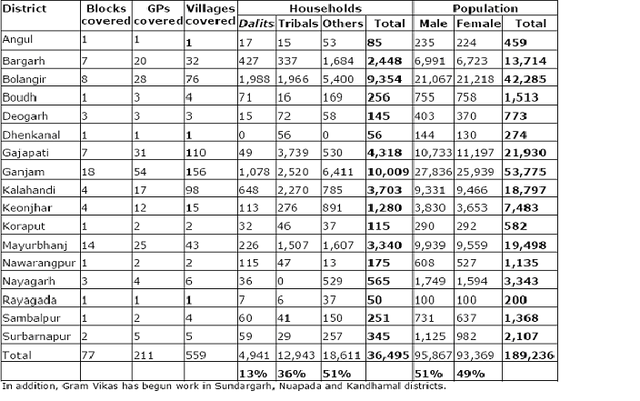
In the 2.5 year project phase GV has reached out to 146 villages covering 6439 families who have been supported to build their own sanitation and water supply infrastructure. An additional 1095 families in Kalahandi have been supported with a partial subsidy of Rs. 500 only , the rest being leveraged udner OTELP. These villages are spread over 12 districts in Orissa. The major concentration of families has been in Gajapati, Bargah and Kalahandi districts. Of the 47 villages taken up in the period 2007-2008, all the 2832 families have completed the construction of individual sanitation systems. Water supply systems have been commissioned in 19 villages where people are able to avail piped water facility. In the rest of the villages the water supply system is nearing completion. The 3607 families in villages where the programme was initiated in 2008-2009 have completed the construction upto the roof level and we aim to complete the total construction including painting work within two month time.
The commissioning of the projects have been a dream come true for the communities who had put in a lot of contribution (to the tune of 60-65% for toilets and upto 30% for water supply) and the day water flowed through taps to their homes, their joy knew no bounds.
Provision of piped water supply has been the most significant aspect of pride and an indicator of collective action of the village community towards their development. The stringent norms of MANTRA pay rich dividends for the community, though the initiation of work requiring 100% involvement of all families is quite a tough task. This also leads to delay in the pace of the implementation cycle, but GV has learnt that taking a shortcut approach has not had positive outcome in the long run.
The ardous task of fetching water and the humilitation faced because of having to relieve oneslf in the open are eliminated. However GV needs to continue the process of educating people on hygiene behaviour, strengthening village committees to monitor whether every person is using the toilets and keeping them clean, accompanying committee members and other people to seek other development funds from the government , and work with women to strengthen their SHGs.
Steps have been initiated to foster equity in water use and reduce wastage of water. In villages where water is pumped from deep tube wells using electricity, we have proposed to install water meters for each family. The committee will decide on the tariff to be put per litre of water consumed. In this process, families with less members and less consumption will pay less and families with more members and more consumption will pay as per use.
Formation of Village Committees
In all the 146 villages, a 12 member village committee has been formed which is registered as a “Society” . The registration process is completed for 61 villages and for the rest of the villages the paper work is pending.
The village committes have been instrumental in the implementation process and have taken the responsibility for coordinating the progress of work with each family.Equal representation of women is ensured in the committee and they are encouraged to voice out their concerns and expectations. Women have also become active proponents in cases where due to some conflict, male members have stalled the work.
Involvement of women members
Women in villages are encouraged to actively participate in the process of decision making and programme implementation. In general body and executive committee meetings presence of women is ensured to a minimum of 50%.
250 Self help groups of 1300 women members have been encouraged to initiate savings and credit activity. Of this 145 groups have initiated income earning activities which include cattle rearing, small vending and tailoring. The total savings in these groups is Rs.9.75 lakhs
Gram Vikas will continue to strenghten education on hygiene behaviour and build capapcities of village communities to contain defaulters who still might continue open defecation.
In all these villages , communities have designed mechanisms for regular operations and maintainence. In villages where electricity is used for pumping water, the village committee has hired a pump operator who is paid through community contribution.
Analysis of Efficiency: Gram Vikas had set a target of reaching out to 6600 families during the project period. The total number of families reached have been 6439. An additional 1095 families have been covered in Kalahandi district with a subsidy support of only Rs. 500 from SDC, the rest being leveraged under OTELP. There has been a saving on the budget under sanitation subsidy to the extent of Rs. 14.50lakh. The savings has been invested in activities that can foster equity within the water and sanitation programme. 4000 water meters and 5000 buckets and mugs have been procured to be provided to families on part subsidy and part cost.
Additional funds to the extent of Rs. 18 million have been leveraged from various government development schemes and development funds of people’s representatives. The impact of this has been on the widespread demonstration of the programme in various parts of Orissa.
Sustainable Livelihoods
Gram Vikas has combined the hardware component of the MANTRA programme and training in masonry to rural youth and added a livelihood component as part of the programme. Unlike other livelihood generating activities which are mostly land or animal based, Gram Vikas invests in training rural youth in diverse trades – masonry, plumbing, bar bending , scaffolding. The results have been encouraging since undergoing a 60-75 day training programme , most trainees have been found to earn 2.5% above their earlier income and have gained employability of 15 additional days per month. In the 2.5 year project period 295 youth have been trained in masonry.
An analysis of the efficiency within this activity shows that an investment on an average of Rs 3200-3400 per person undergoing training in masonry has led to two fold increase in wage earning capacity after a small period. Comaprison or benefit-cost analysis with other livelihood projects show that the efficiency ratio is quite high.
- Impact Assessment (M&E) Phase Project completed on 30 Sep, 2009 Implementation Phase
- Implementation Phase Project started on 1 Apr, 2007 Preparation Phase
-
Chitra Chaudhuri of Gram VikasImplementation Status: completed Wed 06 Sep 2006, Almost 20 Years ago
Sept. 06 Progress Report
This report pertains to the period April 2006 to September 2006 and captures the main activities carried out. Brief narratives on the planned activities and achievements are presented here.
Promoting effective Local Self Governance
-Explore innovative approaches to enhance people’s control over and participation in local self-governance
-Gram Vikas has been implementing the DFID-Orissa Civil Society Programme in tribal areas in Ganjam and Gajapati districts for funding activities related to strengthening civil society in these villages since January 2006. The attempt in this programme is to evoke and realize the potential of ‘critical masses’ and hence, Panchayats where Gram Vikas has covered at least 60% of the population were chosen for the project. Awareness camps were conducted in the project areas. In the last six months, micro plans were prepared for 17 villages. Here, people identified resources available in their village. A thorough analysis of challenges faced and existing opportunities was also carried out. These plans are being followed up with individual villages in some cases and in groups of villages wherever possible.
In the last six months, two trainings were organised for staff, where they were oriented towards the different methods of conducting participatory rural appraisals and regarding PRIs in general. Two trainings were also organised for communities, where the focus was on the upcoming Panchayati Raj elections in Orissa – on the roles and responsibilities of village communities in displaying their effectiveness of being “critical masses” in their respective Panchayats.In the coming months, as a part of this programme, community based organisations in the chosen villages would network among themselves towards forming a joint strategy for the 2007 Panchayat elections.
In addition to all this, a networking workshop was held in Tarava Panchayat in Gajapati, which attracted over 1000 people from over 25 villages. Also present, were all the important officials of the district administration. There were many present in this camp, who came from villages that were outside of Gram Vikas’ existing operational areas. Villages, where we had carried out the micro planning exercises presented, their problem areas and their development plans in front of the government officials and office bearers of Panchayats. The District Collector sanctioned many projects on the spot. In addition, there was extensive discussion on the implementation of NREGA in the district. Villagers brought out clearly, their grievances against the errant government officials who had been hampering the proper implementation of the scheme.
The district administration also answered many questions from the people on PRIs and the forthcoming Panchayat elections. Rs. 17.55 million was sanctioned for water and sanitation activities in schemes such as Swajaldhara rural drinking water supply and for the construction of roads, ponds, community halls, village electrification and other development activities.
Trainings in masonry were carried out in 8 villages spread over 6 districts. The training was held over sixty to seventy-five days, in course of which, the trainees covered all aspects of construction. The Gram Vikas project office arranged for a master mason and an on-site engineer to conduct these trainings, while the regular Gram Vikas staff did the daily monitoring of the training.
During the lean season, those who do not wish to find employment with outside contractors shall be employed with Gram Vikas as masons in the MANTRA programme. After one year, Gram Vikas shall run a follow-up survey to assess the impact of the skill development training in improving the livelihoods of the participants. -
Chitra Chaudhuri of Gram VikasImplementation Status: completed Thu 31 Mar 2005, About 21 Years ago
March 05 Progress Report
This report pertains to the period April 2004 to March 2005 and captures the main activities carried out. Activities for the most part were on track, but were affected in some areas due to early onset of monsoons.
In this period we continued the process of preparing plans for community managed water supply and sanitation, which were discussed and passed by the Palli Sabha. A total of 106 proposals have been passed by Palli Sabhas for funding under Swajaldhara till March 2005. Accessing government resources. 74 villages accessed Rs.5.5 million for water supply and sanitation
In addition to these 203 villages leveraged 23.7 million for other development activities including construction of roads, ponds, school buildings, community hall, etcField teams of Gram Vikas participate in the conduct of Palli Sabhas and Gram Sabhas regular basis in all 15 districts where we work. Capacity development of community leaders and staff in effective functioning of Panchayats continues.
Gram Vikas is among ten state level organizations selected for funding under the DFID Civil Society Organization Programme. Work on the programme is yet to begin as funding is affected by bureaucratic delays.Village committees are registered under the Societies Act 1860, giving them institutional autonomy to access, generate and utilise funds. Most committees have monthly meetings and sometimes more frequently depending on the activities in each village. The status of finances is shared periodically to maintain transparency in transactions. The details of major activities and financial contributions are also put on public display in each village.
Training men and women in masonry, stone cutting, wire bending, carpentry and plumbing. is integrated with the process of infrastructure development in all villages through on-the-job training.
Over the year 287 persons (222 men and 65 women) were trained in masonry in 12 programmes at different project locations.
The training duration is 60 days at the end of which as test is conducted. 210 persons (163 men and 47 women) passed the training programme.At the end of the year 60 persons (57 men, 3 women) were
undergoing training at 3 projects. Trained masons have since been able to find regular employment and are not dependent on Gram Vikas. A process of monitoring progress of masons to assess the efficacy of the training has been put in place.Training of 30 barefoot Engineers
A “barefoot engineers” training programme was started by the Building Support Team (BST) of Gram Vikas in 2002 to develop a cadre of trained persons to support the construction works undertaken by Gram Vikas, capable of carrying out basic engineering tasks at the village level. This was found necessary, as it is difficult to motivate and retain qualified engineers to live and work in remote rural areas. The barefoot engineering programme is integrated with Gram Vikas interventions in water supply and sanitation, housing, renewable energy, watershed development and masons training. Each training cycle involves a 150 day-course curriculum with 90 days theory-practical sessions and 60 days on-site training.A total of 66 persons were trained over the past two years in three batches. 52 persons passed the course, of which 30 continue to work with Gram Vikas, supporting field projects.
The curriculum so far has primarily been geared to supporting the rural housing programme. From internal review of barefoot engineers who have been placed with the projects for the past two years, we realized that there needs to be greater focus on developing capacities for the water supply and sanitation infrastructure. The Barefoot Engineers Programme is currently being reviewed to incorporate syllabi (theoretical and practical) in these critical aspects of Gram Vikas’ habitat programme.Provision of external specialists’ inputs:
Mr Alan Mulvey, Architect from Ireland continued to provide support to and work with the Building Support team of Gram Vikas till July 2004. He is the principal architect of the Office Building on Gram Vikas campus and Aqua Sports Auditorium of DRDA, Ganjam at Chatrapur.Promotion of community owned Vertical Shaft Brick Kilns and HID processes:
The Vertical Shaft Brick Kiln (VSBK) is a cost-effective, energy efficient and environment friendly way of brick production, which originated in China. The technology was brought to India in the late 90's with support from the Swiss Agency for Development Cooperation. Gram Vikas was selected to set up the second VSBKs in the country in 1997 (the first was set up by Development Alternatives). Though brick-making is generally a seasonal activity, the VSBK enables the firing of bricks throughout the year, providing stable employment and income. Gram Vikas saw in this a potential for creating sustainable livelihoods especially for traditional communities of brick-makers.Taking inspiration from the example of the community-managed kiln of Asuramunda in Bolangir, the villagers of Patrapalli in Bargarh district came together to build a kiln themselves. A two shaft kiln with capacity of 7,000 bricks per day was built at a cost of Rs.1,260,000. This was financed by a KVIC group loan for rural industrialisation by the Bolangir Anchalika Gramya Bank (BAGB). Gram Vikas is providing technical support and training in construction and operations. One shaft started operations in November 2004 while the send shaft was started in January 2005. Fifteen moulders families from Partapalli are engaged at the kiln, and 12 youth trained as the fire team.
The operations of the community owned VSBK in Asuramunda, Bolangir were affected by management conflict, which were resolved by the community in course of the year.
In course of the year, Gram Vikas also provided technical support in the establishment of three privately owned VSBKs at Khujenpalli, Bolangir; Rohinia, Bargarh and Sargunamunda, Sonepur. Two private VSBKs are under construction at Gurunthi, Ganjam and Bhatli, Bargarh.
Including the private kiln at Asureswar, Cuttack, Gram Vikas has supported establishment of six private VSBKs. The experience has been essential both in terms of disseminating the technology, as well as building capacities of Gram Vikas in construction and operation of VSBKs.
In course of the year, Gram Vikas decided that we will concentrate on promoting community VSBKs where feasible, rather than private VSBKs, in line with our mission and priority to work with poor and marginalized communities.
Gram Vikas directly operates two VSBKs as demonstration and training units. The downscaled two-shaft VSBK at Mohuda with a capacity of 1.2 million bricks per year was in the fourth year of operation. The kiln began with an opening stock of 0.13 million bricks. During the year 1.02 million bricks were produced (5% damage). 0.91 million bricks were sold and 0.19 million bricks are in stock at the end of the year. Limited availability of appropriate soil has hindered the functioning of the VSBK at Konkia (established in 1997). The kiln was in operation from January to March 2005. During the period 0.28 million bricks were produced and 50,000 sold.
-
Chitra Chaudhuri of Gram VikasImplementation Status: completed Thu 31 Mar 2005, About 21 Years ago
March 05 progress report part two - other activities
1. Strengthening Gender Processes
Gender assessment of Gram Vikas’ activities across all project areas on the basis of defined ‘mechanisms and structures’ are carried out every six months. The field teams prepare these studies. The data is analyzed and discussed and appropriate follow-up action initiated by different project areas. One of the continuing areas of concern has been the representation of women in decision-making bodies at the village level and women holding office-bearing positions.Gender sensitization workshops for staff and community representatives have also been organized.11 training programmes were held last year for 137 men and 43 women staff.
2. Follow up to Gram Vikas 2015 and project level assessments
January 22 marks the Foundation Day of Gram Vikas. Every year community representatives and staff come together at Mohuda around this time for 2-3 days to celebrate the event. This year, the event was restricted to the staff of Gram Vikas and local volunteers associated in our work. There were over 500 participants in the two-day event. On January 21st, staff teams discussed the Strategic Plan of Gram Vikas. The event was an opportunity to gain a common understanding of the vision, mission and strategies of Gram Vikas. The event was also an opportunity to showcase talents of staff in cultural events and sports.3. External training programmes
Staff participated in several training and capacity building programmes. These included the following.
Villagers and staff from Bongamunda watershed project, Bolangir, visited NM Sadguru Foundation for a training and exposure visit on land and water development
Dinabandhu Behura and Ramnarayan Choudhry attended training in watershed development organised at WOTR, Ahmednagar
20 staff went to NM Sadguru Foundation, Dahod for exposure and training land and water development and to ARTI, Pune for understanding the chulha programme
24 staff participated in an exposure and training programme on watershed development at WOTR, Ahmednagar
Training of staff and community representatives on watershed development was organised at Thuamul Rampur project area in Kalahandi facilitated by WOTR, Ahmednagar.
Training of staff and community representatives on vaccination and treatment of livestock were organised at Bongamunda, Bolangir and Thuamul Rampur, Kalahandi facilitated by Dr A J John.
Gram Vikas Education team visited Seva Mandir to learn from the bridge course programme
Subrath Rath, Taraprasad and Surendra Nayak attended the training of trainers in Swajaladhara at NIRD, Hyderabad
Manata Panigrahi, Damayanti Das and Dilip Choudhry attended the training in micro-finance and credit for the poor at NIRD, Hyderabad
Kailash Sahu and Jagdish Patnaik attended the training on participatory micro-planning, implementation and monitoring of rural development programmes at NIRD, Hyderabad.
Gobardhan Pradhan attended the programme on training methods and communication skills at NIRD, Hyderabad
Meenaketan Mohanty attended a workshop on promoting citizen's initiatives on quality primary education organised by CYSD, Bhubaneshwar.
Dayanidhi Mishra attended training on sustainable livelihoods through government aided programmes organised by INSA, Bangalore
Mukta Rosan Jojo, Umakanta Nayak and Digambar Dasbabu attended the planning workshop for Orissa Tribal Empowerment and Livelihoods Programme (OTELP) at Bhubaneshwar
Sojan and Dipti attended the Workshop on Biosand Filters Training in Madurai by DHAN Foundation
Jayapadma, Sojan Thomas, Chandramohan Patnaik, Valsamma Melanoor and Sasha Kiessling visited some project areas of Seva Mandir.
Sasha Kiessling visited Aga Khan Rural Support Programme and Development Support Centre in Gujarat as part of an a study of role transformation and withdrawal strategies adopted by different organizations.
Liby Johnson and Michael Tuckwell visited several energy projects across the country including Odanthurai, Tamil Nadu; TIDE Technocrats, Bangalore, Indian Institute of Science, Bangalore; SWRC, Tilonia; Development Alternatives, Jhansi.
Jayapadma participated in an HID Learning event organised by SDC and Jan Vikas at Ahmedabad.4. PMED capacity building at project level
Continuous efforts are made at capacity building of staff in PMED processes. Much progress has been made in synergising programme and finance monitoring of Gram Vikas. This is assisted by a computerized database. Project Coordinators and staff have been closely involved in an exercise to synchronize planning and budgeting processes.Team building workshops and training in Gender, Panchayati Raj, Accounts and Documentation were organised at all project areas.
Creative writing workshops were organised at Bolangir, Mohuda and Koinpur. 77 staff across all projects participated in these workshops and wrote about their experiences. A compilation of case studies in Oriya titled ‘Gram Vikas Safalata Samahar’ has been published.Organisation wide Review and Planning events were organised in April and October. Over 100 staff from different project areas participated in each of these events. These events create learning and sharing platforms, and provide a forum where specific policies and strategies of the organisation are discussed.
5. Gram Vikas Fellowships
A film in Oriya titled “The Samantrapur Story” was produced by Gram Vikas, directed by Ms Mina Mishra to explain the processes involved in the Rural Health and Environment Programme. The film is intended to be used as a motivational tool when we work with new villages, which are interested in undertaking RHEP. Discussions held around the film with village communities will help clarify apprehensions, doubts that the community may have in undertaking the programme.The process of documenting Gram Vikas’ experience of twenty five years in development action is being coordinated by Sasha Kiessling, volunteer from Australian Volunteers International. Efforts are being made to bring in voices and experiences of communities, staff, board members, donor agencies, friends and well-wishers. The document is geared to capturing the learning in the journey, highlighting both successes and failures.
-
Chitra Chaudhuri of Gram VikasImplementation Status: completed Wed 31 Mar 2004, About 22 Years ago
March 04 Progress Report
Training of PRI functionaries and village leaders continued during this period.
In this period we continued the process of preparing plans for community managed water supply and sanitation, which were discussed and passed by the Palli Sabha.
We also participated in the conduct of Palli Sabhas and Gram Sabhas during February 2004, where in implementation of programmes were reviewed and micro plans prepared for the next financial year.
Gram Vikas is among ten state level organizations selected for funding under the DFID Civil Society Organization Programme. The proposed programme focuses on strengthening capacities of five selected Panchayats. Work is expected to start later this year.
Strengthening Gender Processes:
A study across Gram Vikas project areas is being carried out currently to assess how far gender has been mainstreamed within Gram Vikas and its field level interventions. This report is expected to be completed by June 15, 2004.
Follow up to Gram Vikas 2015 and project level assessments:
The Strategic Plan for future action of Gram Vikas was presented to the members of the Governing Board of Gram Vikas. Other related institutions and individuals were also called upon to gie us feedback on the same. The main approach document of the Strategic Plan has been finalized. We are working on the operational part and HID systems to be brought into place to execute the Strategic Plan on the basis of a consensual understanding on HID was evolved in a workshop of the Management Team and senior coordinators of Gram Vikas in February 2004.
Project profile review reports have been prepared to provide a basis for discussions at the project level in evolving specific plans for implementation by Gram Vikas projects.
External training programmes:
Thirty one Gram Vikas staff participated in training programmes conducted by external institutions including National Institute for Rural Development, Hyderabad; Society for Participatory Research in Asia, New Delhi; Indian Social Institute, New Delhi; Auroville, Pondichery; Search, Bangalore.
Staff and Community representatives went for an exposure visit to TERI gasifier and micro hydro project in Uttaranchal. Two barefoot engineers also trained with two architects for five months at Bhagvatulla Charitable Trust, AP, in a project facilitated by A&D, Vishakapatnam.
PMED capacity building at project level:
The Creative Writing Workshop held in July 2003 was followed up through feedback and discussion to prepare a publishable document for Gram Vikas. Two trainings were organized for all PMED staff.
Much progress has been made in synergizing programme and finance monitoring of Gram Vikas. Project Coordinators and staff were also involved in an exercise to synchronise planning and budgeting processes. The current format is such that it is able to draw up an overall Gram Vikas plan and budget with ease, while retaining individual location specific plans of different projects.
Gram Vikas Fellowships:
A film in Oriya titled “The Samantrapur Story” was produced by Gram Vikas, directed by Ms Mina MIshra to explain the processes involved in the Rural Health and Environment Programme. The film is intended to be used as a motivational tool when we work with new villages, which are interested in undertaking RHEP. Discussions held around the film with village communities will help clarify apprehensions, doubts that the community may have in undertaking the programme.
Gram Vikas contracted the Communication for Development and Learning (CDL), Bangalore to develop a document on twenty five years of Gram Vikas’ work. The document produced has however not been very satisfactory. We are currently trying to identify suitable persons to help us in this effort.
Training of 200 masons with funding from this programme and 100 with other funds:
135 trainees went through the masons training programme. Training programmes were held at 9 different remote rural locations where Gram Vikas operates. Negotiations are also on with SIDBI and CAPART for supporting training programmes.
Training of 30 barefoot Engineers:
Training of the third batch of Barefoot Engineers was started in November 2003 with 27 trainees. The batch will complete training in May 2004. Of the 18 persons who passed in the second batch in May 2003, 15 continue to work with Gram Vikas.
-
Chitra Chaudhuri of Gram VikasImplementation Status: completed Tue 30 Sep 2003, Over 22 Years ago
Status report for the period July to September 2003
The main activities in the first fifteen months (April 2003 to June 2004) have involved understanding the nature of financing available with Panchayats and utilisation. In making the plan, the assumption was Panchayats and in turn village institutions are not able to work with and demonstrate management and utilisation of resources since their access is limited.
Certain developments in the past year have made us review this. Government of India announced the Swajaldhara scheme for rural drinking water supply. This places large resources at the disposal of village institutions through Panchayats. This is related to Gram Vikas’ core programme of promoting rural drinking water supply. Our focus therefore is to use this as the plank for strengthening Panchayats and village institutions’ capacities.
Proposals for Swajaldhara have been forwarded after organizing Palli Sabha and gaining consent of the Gram Panchayat members in **** villages worth Rs.****** . Sanction from district level offices is awaited.
Training programmes for community leaders and Panchayat functionaries across different projects of Gram Vikas were limited this being the peak of the agriculture season. However, staff level training programmes and community level meetings were conducted. A detailed report will be presented at the end of March 2004.
Gram Vikas has also been participating in the Steering committee of the DfID Orissa Civil Society and Poverty Programme in drafting the guidelines and invitation of proposals.
The VIMISTRAGO document setting out Gram Vikas’ Vision, Mission and new strategic plan was presented to the members of the Governing Board in July 2003. There was debate and discussion in this regard and the feedback brought on board. While the suggestions of the Board members are being incorporated into the document, simultaneous processes are underway to formulate project specific plans. The process is expected to be completed by March 2004.
A creative writing workshop was held in July 2003. Over 50 case studies, written by field level workers of Gram Vikas, were collated in this process. This will be edited and brought out in a publication for Gram Vikas’ 25th Anniversary celebrations.
Another area of intervention is training of PMED staff members at the projects. This is with a view to strengthening PMED mechanisms at the project level. A training on proposals and budgets and data analysis was held from July 28-30, 2003.
A significant area under the HID intervention is to strengthen the gender focus within the organization and integrate it within all programme interventions of Gram Vikas. This is in progress and a consolidated report will be presented at the end of March 2004.
A study of Self Help Groups was also conducted and the information analysed and brought out as a report. This is being used for discussions to steer the gender processes through self-help groups.
A framework or cost benefit analysis of the RHEP was developed and field tested. The report is being circulated for comments, and will be used to broaden the scope of the study.
The Communication for Development and Learning (CDL) Bangalore has been selected to prepare a document of Gram Vikas’ development experiences to be launched at the celebration of 25 years in January 2004.
The specific plans under this head include training of 300 masons. This will be started in November 2003. There has been no further development in efforts to lobby with SIDBI and DRDA for masons training funds.
The interviews for the new batch of Barefoot engineers will be conducted in end-October and the new session will commence in November 2003An initial survey of masons and barefoot engineers was conducted in April-May 2003. A follow survey is proposed at the end of six months. Appropriate software has been designed to track progress.
Technical personnel support will be extended to habitat related activities in different villages. Gram Vikas also plans to construct one demonstration building using CEEF technologies to create increased awareness among the general public. Services of a design consultant will be utilised for demonstration as well staff capacity building purposes.
From July 2003 onwards the activities hitherto carried under India Brick Project have been brought under the purview of MANTRA. A meeting with the PFU was held in Raipur in July 2003. the project received a boost as the Asuramunda experiment received the Tech Museum Laureate award from the Tech Museum for Innovation, San Jose, California.
The plans for the second community owned kiln at Patrapalli in Bargarh district are at an advanced stage. Technology support is also being provided for three private kilns.
-
Chitra Chaudhuri of Gram VikasImplementation Status: completed Fri 20 Sep 2002, Over 23 Years ago
Sept. 2002 Progress Report
This report is a review of the activities under the programme during the first six months – April to September 2002.
Six months is not normally a long period in the life of an organization; however, these six months under review proved to be quite remarkable for Gram Vikas. Following is a review of activities during the period, against those planned.
Gram Vikas is receiving support under a project supported by PRIA for undertaking capacity development activities for Panchayats. This is ongoing and will be completed in December 2002. Activities under Vikas MANTRA will begin after this period.
Initial discussions are underway to make a film on the Rural Health and Environment Programme of Gram Vikas. This film is expected to be completed by December 2002.
Barefoot Engineers: The selection of trainees for II batch of training is scheduled for October 2002. The first batch of training was completed as planned in June 2002. The second batch will start in November 2002. External specialist inputs for training & design was not undertaken as plans made for revision of curriculum of BE training has been postponed till the completion of the third batch of training
Clients for the housing programme have been selected; support has been provided during the period.
During the period Gram Vikas undertook the construction of 19 high school buildings for the Government using CEEF technologies. A cultural centre in Berhampur is also being built by Gram Vikas.
A revolving fund has been created for advance financing of house construction in rural areas. The specified amount has been added to the safety net created by Gram Vikas.
The past six months has seen considerable change in the gendering process of Gram Vikas in relation to its programmes and activities. In the early part of last year, we had Ms. Helena Zweifel from SDC who was invited to start off the gender process in the organisation. A gender policy of the organisation was finalised and later a detailed action plan for each project was formulated which incorporated gender into the existing programmes without isolating it as a separate programme. With the workshop held in March 2002, important decisions in the sectoral strategies utilising a gender perspective were made. These decisions would be the focus of our work in all the programmes. The last 6 months have seen a definite shift from just implementing gender sensitive programmes to more of sensitisation and discussions. Action plans made on field realities were formulated individually by each project relating to their reality.
Successes: In Bargarh, a tailoring class was set up for girls who have completed high school and who would not be pursuing their education due to financial reasons. The class took a loan from the SHGs to purchase sewing machines and have been able to start off repaying their loan. Some women SHGs in Bargarh have organised public holiday celebrations like Independence Day in their villages. In each of the interim phase villages under the Bargarh Project, a woman has been made the co-signatory of the Fixed Deposits. In Mayurbhanj, the process to form Mahila Samiti in each of the villages has started.
FAILURES: 100% girl child retention in school is yet to be achieved in most villages. Less emphasis on technical training for women. Staff level sharing is not taking place with due emphasis. No gender sensitisation workshops at project level have taken place.
MANTRA (2002-2007) and SDC have partnered so that over 22,000 households benefited from water and sanitation. The current phase of SDC-Gram Vikas collaboration focuses on extending the MANTRA programme in Orissa over a two and a half year period.
Narrative
With continued support from SDC, we seek to sustain the momentum of the programme while furthering this process in the next three years. We will further the four major projects under MANTRA – Village Institution-Building and Water and Sanitation and Technician’s Training, and Health/ Hygiene Training.
Water and sanitation intervention:
In the 2.5 year project phase GV has reached out to 146 villages covering 6439 families who have been supported to build their own sanitation and water supply infrastructure. An additional 1095 families in Kalahandi have been supported with a partial subsidy of Rs. 500 only , the rest being leveraged udner OTELP. These villages are spread over 12 districts in Orissa. The major concentration of families has been in Gajapati, Bargah and Kalahandi districts. Of the 47 villages taken up in the period 2007-2008, all the 2832 families have completed the construction of individual sanitation systems. Water supply systems have been commissioned in 19 villages where people are able to avail piped water facility. In the rest of the villages the water supply system is nearing completion. The 3607 families in villages where the programme was initiated in 2008-2009 have completed the construction upto the roof level and we aim to complete the total construction including painting work within two month time.
The commissioning of the projects have been a dream come true for the communities who had put in a lot of contribution (to the tune of 60-65% for toilets and upto 30% for water supply) and the day water flowed through taps to their homes, their joy knew no bounds.
Provision of piped water supply has been the most significant aspect of pride and an indicator of collective action of the village community towards their development. The stringent norms of MANTRA pay rich dividends for the community, though the initiation of work requiring 100% involvement of all families is quite a tough task. This also leads to delay in the pace of the implementation cycle, but GV has learnt that taking a shortcut approach has not had positive outcome in the long run.
The ardous task of fetching water and the humilitation faced because of having to relieve oneslf in the open are eliminated. However GV needs to continue the process of educating people on hygiene behaviour, strengthening village committees to monitor whether every person is using the toilets and keeping them clean, accompanying committee members and other people to seek other development funds from the government , and work with women to strengthen their SHGs.
Steps have been initiated to foster equity in water use and reduce wastage of water. In villages where water is pumped from deep tube wells using electricity, we have proposed to install water meters for each family. The committee will decide on the tariff to be put per litre of water consumed. In this process, families with less members and less consumption will pay less and families with more members and more consumption will pay as per use.
Formation of Village Committees
In all the 146 villages, a 12 member village committee has been formed which is registered as a “Society” . The registration process is completed for 61 villages and for the rest of the villages the paper work is pending.
The village committes have been instrumental in the implementation process and have taken the responsibility for coordinating the progress of work with each family.Equal representation of women is ensured in the committee and they are encouraged to voice out their concerns and expectations. Women have also become active proponents in cases where due to some conflict, male members have stalled the work.
Involvement of women members
Women in villages are encouraged to actively participate in the process of decision making and programme implementation. In general body and executive committee meetings presence of women is ensured to a minimum of 50%.
250 Self help groups of 1300 women members have been encouraged to initiate savings and credit activity. Of this 145 groups have initiated income earning activities which include cattle rearing, small vending and tailoring. The total savings in these groups is Rs.9.75 lakhs
Gram Vikas will continue to strenghten education on hygiene behaviour and build capapcities of village communities to contain defaulters who still might continue open defecation.
In all these villages , communities have designed mechanisms for regular operations and maintainence. In villages where electricity is used for pumping water, the village committee has hired a pump operator who is paid through community contribution.
Analysis of Efficiency: Gram Vikas had set a target of reaching out to 6600 families during the project period. The total number of families reached have been 6439. An additional 1095 families have been covered in Kalahandi district with a subsidy support of only Rs. 500 from SDC, the rest being leveraged under OTELP. There has been a saving on the budget under sanitation subsidy to the extent of Rs. 14.50lakh. The savings has been invested in activities that can foster equity within the water and sanitation programme. 4000 water meters and 5000 buckets and mugs have been procured to be provided to families on part subsidy and part cost.
Additional funds to the extent of Rs. 18 million have been leveraged from various government development schemes and development funds of people’s representatives. The impact of this has been on the widespread demonstration of the programme in various parts of Orissa.
Sustainable Livelihoods
Gram Vikas has combined the hardware component of the MANTRA programme and training in masonry to rural youth and added a livelihood component as part of the programme. Unlike other livelihood generating activities which are mostly land or animal based, Gram Vikas invests in training rural youth in diverse trades – masonry, plumbing, bar bending , scaffolding. The results have been encouraging since undergoing a 60-75 day training programme , most trainees have been found to earn 2.5% above their earlier income and have gained employability of 15 additional days per month. In the 2.5 year project period 295 youth have been trained in masonry.
An analysis of the efficiency within this activity shows that an investment on an average of Rs 3200-3400 per person undergoing training in masonry has led to two fold increase in wage earning capacity after a small period. Comaprison or benefit-cost analysis with other livelihood projects show that the efficiency ratio is quite high.
Photos
Documents
-
Caste-wi...
-
Demograp...
-
Appendix...
-
150_vill...
61 Sites
- Site
- Site
- Site
- Site
- Site
- Site
- Site
- Site
- Site
- Site
- Site
- Site
- Site
- Site
- Site
- Site
- Site
- Site
- Site
- Site
- Site
- Site
- Site
- Site
- Site
- Site
- Site
- Site
- Site
- Site
- Site
- Site
- Site
- Site
- Site
- Site
- Site
- Site
- Site
- Site
- Site
- Site
- Site
- Site
- Site
- Site
- Site
- Site
- Site
- Site
- Site
- Site
- Site
- Site
- Site
- Site
- Site
- Site
- Site
- Site
- Site
Sustainability
Creating and measuring long-term impact
Raising the Village corpus
The Village corpus is a mechanism towards sustainability as well as an indicator of the commitment of the village/ community towards the ownership of the programme. In some villages people contribute cash upfront towards the corpus, whereas in many instances, mechanisms of deduction from the subsidy provided by Gram Vikas or transferring the subsidy availed from the government and thereafter depositing it in the village corpus are in vogue. The total corpus raised in cash is Rs. 35 lakhs and the rest is in the form of materials procured with the corpus collection.
Learnings
Knowledge of project and process for sharing
Improvement in behaviour with respect to open defecation is evident in 19 villages where the water supply has been established within the two year period. However it is too early to state the improvement in health conditions in the villages supported by SDC in this period. We will continue to collate data on a monthly basis on health indicators which will be analysed over a year. However empirical data of previously implemented projects show 85% reduction in incidence of water borne diseases.
Process of inclusion and democracy is experienced in the villages; sense of ownership of the water and sanitation program by the villagers is perceived. Community contribution has been more than 60% towards the cost of sanitation infrastructure and insistence on 100% coverage has motivated communities to cooperate with economically weaker sections in the village and support them collectively to build their infrastructure.
Women and men as well as all castes in the villages participate in decision-making processes at the village level. Data of participation in meetings show that on an average there is 45% presence of women in the general body meetings and 50% presence in executive committee meetings. Presence of women in meetings helps to give momentum to the programme as women benefit directly from the outputs of the programme.
Members of the village executive committee are able to manage and maintain the water and sanitation facilities; they are able to monitor use of toilets and use of water . Members of village committee have also been capable to leverage funds from government sources – Rs. 18.4 million have been leveraged under government schemes and Local area development fund in 35 villages. In the remaining villages the fund sanction process in underway and it will be received within this year.
Maintenance of water and sanitation facilities are financially sustainable with communities taking care of the Operating & Maintenance costs. Through the corpus fund inclusion of new households whenever required is ensured. Corpus fund have been set up in all the villages and maintenance fund is developed in villages where water supply has been commissioned.
Impact
People Getting Safe Drinking Water: 10165
People Getting Sanitation: 10165
People Getting Other Benefits: 10165
An integral component of the MANTRA programme is to build on the strength of communities. Towards this, a diverse range of capacity building initiatives has taken place in this period with a range of groups.
Within the districts SDC are involved with supporting there have been over 100 trainings, including school sanitation training, leadership trainings, SHG trainings, and health camps. These have involved more than 2000 men and 1500 women.
To enhance livelihood options for the unskilled youth (men and women) in the construction sector the collaboration is facilitating skills trainings. Training of village youth, both men and women is ongoing with the dual purpose of enhancing skills that contribute to improving their livelihood as well as have a pool of trained people to take up construction work in the villages.
A review and assessment of the impact of these trainings carried out between 2005 and 2007 is currently underway. 210 trained masons were surveyed, and the preliminary findings show that on average the numbers of days worked per month increased by 8 and the daily wage increased by nearly Rs.70. The monthly average increase in wages was Rs.1763, which amounted to a more than 300% increase in monthly wages.
The three main ways masons felt they had benefited from the training was:
1. Increased employment opportunity
2. Increased income
3. Gained a new skill
Photos
Documents
-
Caste-wi...
-
Demograp...
-
Appendix...
-
150_vill...
61 Sites
- Site
- Site
- Site
- Site
- Site
- Site
- Site
- Site
- Site
- Site
- Site
- Site
- Site
- Site
- Site
- Site
- Site
- Site
- Site
- Site
- Site
- Site
- Site
- Site
- Site
- Site
- Site
- Site
- Site
- Site
- Site
- Site
- Site
- Site
- Site
- Site
- Site
- Site
- Site
- Site
- Site
- Site
- Site
- Site
- Site
- Site
- Site
- Site
- Site
- Site
- Site
- Site
- Site
- Site
- Site
- Site
- Site
- Site
- Site
- Site
- Site