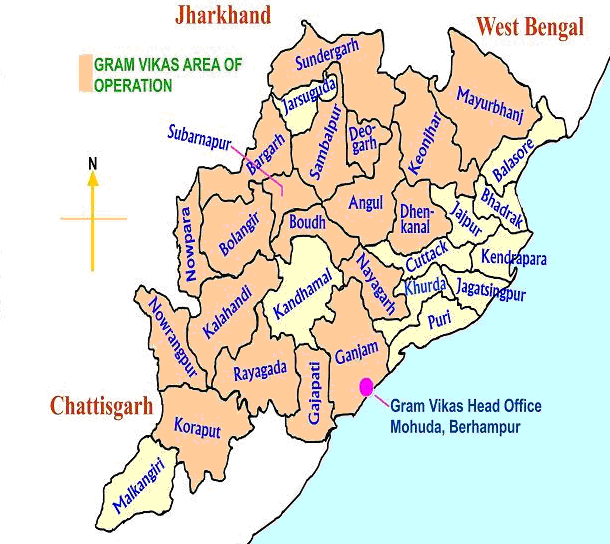
In collaboration with Tata Social Welfare Trust, Mumbai, Gram Vikas is directly implementing the MANTRA programme in Mayurbhanj, Keonjhar, Dhenkanal, Ganjam and Gajapati in Orissa. By March 2010, it is planned to reach out to 10,000 families.
Photos


Documents
-
 Toilet_a...
-
 B._Antar...
-
 B._Antar...
-
 Progress...
-
MTR_GV_1...
-
 Annex_3_...
-
GV-DI.doc
-
Proposal...
-
 Map_of_P...
-
 Map_of_P...

102 Sites
- Site
- Site
- Site
- Site
- Site
- Site
- Site
- Site
- Site
- Site
- Site
- Site
- Site
- Site
- Site
- Site
- Site
- Site
- Site
- Site
- Site
- Site
- Site
- Site
- Site
- Site
- Site
- Site
- Site
- Site
- Site
- Site
- Site
- Site
- Site
- Site
- Site
- Site
- Site
- Site
- Site
- Site
- Site
- Site
- Site
- Site
- Site
- Site
- Site
- Site
- Site
- Site
- Site
- Site
- Site
- Site
- Site
- Site
- Site
- Site
- Site
- Site
- Site
- Site
- Site
- Site
- Site
- Site
- Site
- Site
- Site
- Site
- Site
- Site
- Site
- Site
- Site
- Site
- Site
- Site
- Site
- Site
- Site
- Site
- Site
- Site
- Site
- Site
- Site
- Site
- Site
- Site
- Site
- Site
- Site
- Site
- Site
- Site
- Site
- Site
- Site
- Site
Narrative
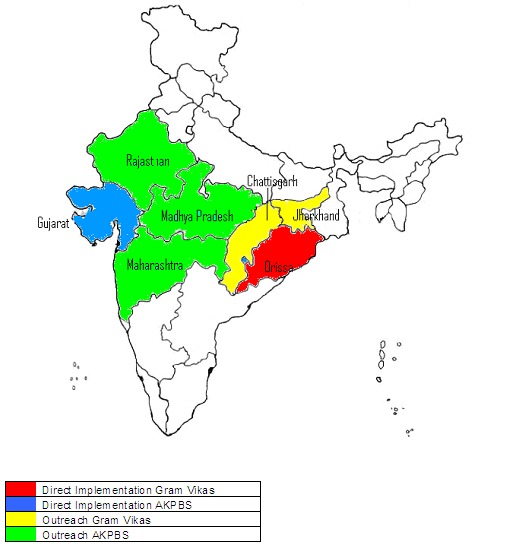
In collaboration with Tata Social Welfare Trust, Mumbai, Gram Vikas is directly implementing the MANTRA programme in the districts of Mayurbhanj, Keonjhar, Dhenkanal, Ganjam and Gajapati in Orissa, and in collaboration with partner organisations in the states of Jharkhand, Madhya Pradesh, Andhra Pradesh, and Maharashtra, as well as the Orissa district of Jagatsinghpur.
In the three-year project period from 1st April 2007 to 31st March 2010, it is planned to reach out to 10,000 families through the MANTRA programme under this collaboration.
Orissa with a population of 38 million of which 87% are rural has the distinction of having the poorest coverage of sanitation and protected water supply. While figures on paper keep changing every year in positive progression, in reality most of the “toilets” promoted by the mainstream agency especially government are unusable or are never made. One of the reasons behind this is the attitude that “poor people need poor solutions”. It is evident in the quality of toilets that are promoted under the Total Sanitation Campaign”. Therefore while progress is apparent on paper, there is no visible improvement in quality of life and health conditions of the people in rural areas.
The operational areas of Gram Vikas have a large tribal population and are physically remote with very poor basic services and facilities, rendering them as districts that have low human development indicators. The communities here depend primarily on agriculture and daily wage labour for subsistence. The vicious cycle of poverty and morbidity work together to keep communities in these areas in a perpetual debt cycle that force them to lead sub- human lives devoid of dignity, self-respect, and the capacity to demand and negotiate with external forces for their rightful entitlement.
In this context, the water and sanitation project is an entry point and through the process of 100% inclusion, the aim is to harness the inherent collective potential of poor communities to help them to determine the course of their development. The MANTRA programme of Gram Vikas was initiated as a response to the abysmal health conditions of the people in rural areas.
On deeper inquiry, health problems were found to be mostly in the realm of water borne diseases caused due to consumption of polluted water. Unhygienic waste disposal habit was found to be a major polluting factor in these areas. The core principle of MANTRA is 100 % inclusion of all families in a village. This is important from a total sanitation point of view , but is also a step towards addressing exclusionary practices prevailing in society –mainly towards dalits, indigenous communities and women.
- Impact Assessment (M&E) Phase Project completed on 31 Mar, 2010 Implementation Phase
-
Chitra Chaudhuri of Gram VikasImplementation Status: completed Mon 21 Dec 2009, Over 16 Years ago
B. Antarsingh Village Profile
Village Profile:
B. Antarsingh consists of 20 households and is located in Gajapati district in Koinpur. The inhabitants of this village primarily engage in shifting agriculture, firewood collection, fruit selling and animal husbandry. Construction of toilet and bathroom facilities in the village began on 05/04/07 and the work was completed on 02/03/08. Following this, work on water supply began on 10/06/09 and was completed on 30/08/09. In order to monitor the situation in the village following the implementation of these facilities, GV staff spoke with the village SHG President and the SHG secretary. This was followed by a men’s focus group discussion consisting of eight men, including the Village President. The aim of these discussions was to get villagers’ perspective about how this process unfolded and its impact on their lives. Below, is a more detailed picture of the discussions that followed.Process:
The villagers at B. Antarsingh identified the need for water and sanitation facilities in their village following an ‘exposure tour’ to Anandpur (a GV model village). The issue was then discussed in several village meetings and upon reaching a common understanding for its need, the villagers approached GV to begin work. Initially, out of 20 households, 6 households were not keen on joining in these efforts. Nevertheless, the remaining 14 families began constructing these facilities by making bricks, following which the 6 families agreed to join in these efforts after concluding that this was “do-able”.
The villagers reported that this was a peaceful process and everyone in the village contributed towards building these facilities. Jeevan Dhara contributed Rs. 1,04,881 towards building the water tank and the villagers contributed Rs. 32,869. In addition, GV also contributed cement, doors and toilet pans. Bucks and mugs were provided on payment by GV. Villagers contributed their labor, transported building materials, did pipeline digging and so forth. Responsibilities were allocated at village meetings which were held on a regular basis. Villagers also helped out those families who were financially and/or materially unable to contribute towards the completion of the project. Additionally, the villagers devised a system of work that allowed them to take turns in constructing these facilities. Accordingly, villagers were divided into 2 groups of 15 each. Groups took turns in working for 7 continuous days followed by 7 days of pursuing other activities such as shifting agriculture and so forth. In this way, the 2 groups took turns and shared the workload.While no masons were trained in this village, masons from other villages helped in constructing these facilities. The men at the village stated that they picked up masonry skills from observing these masons at work. Additionally, they expressed no desire in acquiring masonry skills because they claimed that these skills might be laid to waste considering that there were not many concrete homes around. Besides, they did not want to migrate to other cities in search of work as they had several responsibilities at home. Therefore, men continue to be engaged in NREGS work, shifting agriculture, watershed activities, firewood collection and selling fruits even after the construction of these facilities.
Benefits:
-Safety:
Before the construction of sanitation facilities, both men and women alike reported feeling unsafe especially when they had to leave the house at night as they were afraid of snakes. Hence, they always needed someone to escort them to the nearby fields. Also, during the monsoon season, villagers had to wait till the rains stopped before venturing out, and they always had to carry an umbrella with them; this made it inconvenient. The introduction of sanitation facilities for each household makes it easy, convenient and accessible for all. In fact, in the focus group discussion, all the men unanimously agreed that life is good following the introduction of water and sanitation facilities in the village. Overall, the general view among the villagers was that these facilities are of good quality and that using the toilet and bathroom was no longer time consuming and dangerous.-Water Supply:
Prior to the village receiving a steady supply of water to their toilets, bathrooms and kitchens, women collected water from a nearby well. The water was dirty and unfit for consumption; hence, it had to be boiled each time before use. This was time consuming and it caused interruptions to their daily work routine because they often had to stop what they were doing in the fields or in the mountains and return home in order to fetch water. However, following the implementation of these facilities, women reported that life has become easier for them and that it is convenient now because they receive water in their homes. When asked about their views on this project, one of the men, Bhagyo Khargi, responded by stating that, “We now get clean and pure water”. Additionally, they noted that their wives were much happier now that they no longer had to fetch water from the well. In fact, villagers report that they have become so accustomed to the comfort of receiving water in their own homes that they are not sure if they can go back to living without it! While the village has experienced no problems in water supply till date, villagers worry that the water source will dry up in the summer months.-Privacy:
In the past, women had to bathe in the nearby well, in the presence of other villagers. Women stated that the introduction of water and sanitation facilities allows them bathe in the privacy of their own bathrooms.-Health:
Currently, there is no medical centre in this area and the nearest is in Koinpur, which is approximately 25-30 kilometers away. Moreover, this medical centre is not easily accessible from the village. For instance, villagers create and carry a makeshift stretcher in order to transport pregnant women, the elderly and sick individuals to the medical centre. This involves a 2-3 hour walk over the mountains to reach the nearest road from which they commute to the medical centre by bus or by auto.Villagers reported that following the construction of these facilities, skin diseases and water-borne diseases such as scabies and dysentery have declined over the course of 3 months. In the past, the dirty water in the nearby well was the only source of water for the entire village. As a result, villagers neglected their personal hygiene. Also, because there was only one source of water, skin diseases spread easily among them. However, with the introduction of individual bathing facilities, those who are sick can use their own facilities and not come into contact with other villagers. When questioned about the importance of hygiene, villagers reported that each toilet has soaps to enable them to maintain a good standard of personal hygiene. Education on personal hygiene and cleanliness is passed on to their children by them. Also, children attended a nearby government school which also had good sanitation facilities.
Villagers now cultivate vegetables such as tomato and pumpkins from the water that drains out of the toilets and bathrooms. While the tomatoes are consumed at home, the pumpkins are sold at the local market thus generating an additional source of income.
-Maintenance of the facilities:
Jambubati Raita (the village SHG President) initiated a system whereby SHG members contribute money every month towards buying soap. At each SHG meeting, the soap is then distributed to each member to enable them to maintain the cleanliness of their toilets and bathrooms. If a household fails to comply by neglecting the general upkeep of their facilities, the SHG Secretary-Sunari Sabaram, locks up the respective household’s toilet and bathroom until it gets cleaned. In addition, in order to maintain these facilities, each household contributes 30 rupees a month which goes into the village fund. This can then be used to repair any damages. In fact, currently, villagers reported that this was an important topic being discussed at village meetings. Villagers are now collaborating with GV in order to build a piped drainage system to drain away excess water from the toilets and bathrooms because currently, the water is left to stagnate behind these facilities.
Village-level Institutions:
-SHG’s:
In order to examine the impact of the project in improving their overall quality of life, GV staff questioned the women on the role of SHG’s, and its impact on their lives at both the village and the household levels. The SHG at B. Antarsingh consists of 13 members, and each member deposits 10 rupees a month. So far, there has been only one defaulter who was experiencing financial difficulties. The main topics discussed at SHG meetings are as follows: the importance of collecting money, the importance of cooperation, loan discussions, record maintenance, seasonal business and the importance of maintaining toilet and bathroom facilities. Last year, in 2008, the SHG secured a loan of 18, 000 rupees which the villagers used towards selling fruit, and making and selling brooms. This has generated a profit of 4, 000 rupees. The village SHG secretary, Sunari Sabaram, reported that through their participation in SHG’s, women now command greater respect and have greater decision-making power both at the village and the household levels.-Village-level Institutions:
The village has a female representative at the Gram Panchayat. The following is a list of current issues being tackled by the village. Villagers stated that at least 1 member from each household attends village meetings every month. Currently, villagers are concerned with securing funds to build a piped drainage system. They plan to meet with the Gram Panchayat to discuss matters further. Also, previously, the village had a children’s centre that was government funded. However, it was poorly funded and was of poor quality, and it closed down. Children from the village now attend a children’s centre at a nearby village. Villagers at B. Antarsingh are currently demanding that they get a new children’s centre in their village. Villagers also stated that they are now aware of the ‘Public Distribution System’ scheme run by the government, wherein BPL families are entitled to receive 35kgs of rice and 4 liters of kerosene a month. Lastly, villagers stated that they are now taking the initiative to work with GV in order to identify and avail of relevant government schemes.
Conclusion:
In conclusion, the introduction of these facilities has provided 100% access to water and sanitation facilities for every household in the village. This in turn has affected social, political and economic aspects of life in the village in positive ways. Villagers are now able to grow vegetables such as pumpkin which is sold in the market, thus generating an additional source of income. Also, women are now able to focus on household and income generating activities as they no longer waste time fetching water everyday. Villagers have also been experiencing better quality of both physical and mental health as a result of introducing these facilities. Also, through SHG’s, women now enjoy better social, economic and political status within the village and their households. There is also evidence of the empowerment of village level institutions because of the nature of demands being made at the Gram Panchayat. Overall, this process was a peaceful one that demonstrated evidence of cooperation and social cohesion among the villagers. -
Ky ChungImplementation Status: completed Tue 15 Dec 2009, Over 16 Years ago
Photo visit
Quick trip to document water and sanitation projects for Gram Vikas.
-
 D7A_6834...
-
-
Chitra Chaudhuri of Gram VikasImplementation Status: in_progress Mon 01 Jun 2009, About 17 Years ago
Progress Report June 2009
Water supply:
Of the 42 villages implemented by Gram Vikas directly in 2007-2008, water supply has been commissioned in 15 villages and in the rest of the villages the construction of the water source is completed and the water tank construction as well as laying of distribution pipelines in underway.
For the villages covered in 2007-2008 water works have been initiated in 4 villages. The village in Jharkhand has completed the water supply work.
Completion of construction of toilets and bathing rooms:
The completion of toilets and bathing rooms for the families in villages covered in 2008-2009 is 87%. The rest of the infrastructure will be completed by September 2009. The delay in completion has been to some extent dependent upon all families completing their construction work wherein the poor families have to really make significant adjustments to their regular livelihood and carry forward the construction. Delay to some extent has also been because of suppliers of materials like cement, toilet pans taking time to supply the material on time.
Total families covered for whom subsidy released in 2008-2009 has been 2875 as against 3301 previously reported in April 09. The decrease in families has been because 426 families covered by a partner organisation in Jagatsinghpur were not eligible for the subsidy as they had not adhered to the norms of Gram Vikas. We have provided more training to the staff and communities and hope that these villages can be covered in 2009-2010.
For the period 2009-2010, Gram Vikas has planned to work with an additional 4300 families. The motivation phase is over and the Village committees have been constituted in most cases. The process of corpus collection is underway in the villages.
Involvement of women:
Periodic meetings and informal training sessions have been key to helping women gain confidence, mobilise savings regularly, manage finances and access credit to take up small enterprise. The 50 groups formed last year in the villages have mobilised a savings of Rs. 1.44 lakhs.
Women are also involved in maintaining cleanliness of village, personal hygiene for children, monitoring the coverage of immunisation and growth monitoring of children. In many instances women are also involved in overseeing the mid-day meal scheme of the village school.
Capacity development:
Gram Vikas has been investing in building capacities of field personnel in geohydrology, locating possible water sources and water quality monitoring. Easy to test kits have been procured and provided to the staff to monitor the water quality. We are also exploring possibilities of treatment especially for salination in some cases.
Expansion of the programme:
The expansion of MANTRA programme within Orissa is promising with more NGOs coming forward to implement the programme. The challenge however lies in the start up time and hand holding support that these partners require. It also poses challenge for the new NGOs to complete the physical work in a limited one year period.
During the year new collaboration has been initiated with Srishti in Keonjhar district.
Management System:
The Programme Manager oversees the implementation of the programme and monitors the quality as well as progress against plans. The Planning Monitoring team supports the Programme Manager in analysing and tracking progress, documenting good practices and training materials required for the project.
Annual plans are prepared by each project and consolidated at the Head Office as part of the annual plan of Gram Vikas.
Regular monitoring works through a systematic monthly progress report submitted by each of the projects to Head Office. Data is collected from every village to monitor project progress, which includes the number of meetings held, and number of people who attended, including a breakdown of number of men and women attending. Key data collected also includes the progress of the water and sanitation infrastructure being built, as well as incidence of diseases, especially water-borne diseases. These village reports are then consolidated at the project level, before being sent to Head Office as a project report. The data is then put into a database where project progress can be tracked, and reports generated.
-
Chitra Chaudhuri of Gram VikasImplementation Status: in_progress Sun 01 Mar 2009, Over 17 Years ago
March 2009 Progress Report
In the period April 2008-March 2009, Gram Vikas has directly implemented the sanitation and water supply project in 59 villages in 6 districts within Orissa, and 1 district in Jharkhand, with the support of the Tata Social Welfare Trust. The total number of families covered is 3226.
Formation of Village Committees:
Involvement of all households is facilitated through general body meetings where the head man and woman of the household participates in the decision making process. The general body as a forum is also used to provide detailed information about the programme, spells out roles and responsibilities of Gram Vikas and the village, availability of raw materials, masons, finance etc. Slowly this body also makes and enforces norms related to containing open defecation, maintaining cleanliness of village surroundings, and rules related to the payment of tariffs. These meetings are held on a monthly basis, and across all the villages there have been over 100 meetings in the past year. On average the attendance of women at these meetings is around 31%, although it has been observed that participation of women has increased at the meetings. (Data collected from the Monthly Progress reports)The general body selects a twelve member Executive Committee to take care of the day-to-day responsibilities of seeing that all households obtain their materials on time and initiate the construction. They also resolve conflicts and disputes that arise in the course of the work.
The Executive body of each village is registered under the Societies Registration act, 1860 that makes them a legal entity and enables them to source development funds for their villages. During this period, 20 village committees in the new batch of villages have completed their registration, with the remaining villages in progress. Over the past year there have been 92 VEC meetings, with the majority of villages holding meetings once a month. Currently the average percentage of female members is 46%. However, with further capacity building of women, and gender training for both men and women, we are confident this number will reach the required 50%.
Involvement of women:
Organising women into small groups have helped them to increase their savings and access to small credit, but a key change is perceptible in the level of confidence that women members are gaining enabling them to speak out in village meetings. Over the past year, throughout all of the villages, nearly 50 SHGs have been established, not only enabling women to gain confidence, but also allowing groups to save money and form linkages with banks. Ganjam district celebrated International Women’s Day, which included a legal literacy camp involving 271 women.Raising the corpus:
Previous years’ villages have mobilized a village corpus fund of on average Rs.1000 per household. For this year’s villages, the total corpus collection is Rs.343,000 in addition to Rs.28,000 worth of local material, such as sand and stones having been collected.Construction of toilets and bathing rooms:
Of the 59 villages where the sanitation and water supply work has been initiated as an entry point under MANTRA, 166 families have completed the construction in all respects and 441 households have completed the casting of their roof.For the sanitation work, Rs.17,30,800 has been sanctioned from three sources; MLA LAD (Rs.9,27,000) ITDA (Integrated Tribal Development Agency) (Rs.2,14,000), and TSC (Total Sanitation Campaign) (Rs.5,89,800). Of the total amount sanctioned, Rs.13,46,800 (78%) has been received.
To complete the water supply component of projects, over 2 crore has been mobilised from both government and non-government sources. To date, just over 10% of this total amount has been received.
Of the 46 villages under previous years’ funding by TWST, 20 have completed the construction of the water supply, with 13 of these having been commissioned, the remaining water supply systems are under construction.
In areas where the topography allows for it, gravity-flow systems are used for transporting water. Suitable perennial springs are tapped, and water is transported through a series of pipes downhill to the village overhead tank. Where there is no suitable spring, Gram Vikas have developed an innovative solution where a sanitary well is established, and spring water is induced. Gravity-flow is the preferred method for transporting water, as not only is it ecologically sound, but it removes the need for pumps, and therefore the cost of diesel, kerosene or high electricity charges. In 18 of the villages, it has been possible to implement gravity-flow systems. In the other villages, bore wells have been established.
Issues and Challenges:
Challenges remain in terms of motivating villagers to achieve 100% inclusion and to complete the hardware within a one-year time scale. Rising costs of raw materials has been a concern, as the subsidy component has remained the same as previous years. This entails more contribution from individual families, which takes a lot of time. Poor families find it very difficult to mobilise funds for the construction and to complete the work within the stipulated time frame. Wherever possible, Gram Vikas tries to influence the people’s representatives and local governments to provide support or mobilise funds from the banks to support such cases.
With regard to the MANTRA expansion programme, the challenges in the initial phase remain in terms of handholding and facilitating partner organisations to make every effort to follow the MANTRA principles. Therefore the progress of work has been slow. We hope that with committed personnel from our side, including the addition of a programme manager to take forward the expansion plan, we may be able to move with greater clarity on selection of partners and providing the necessary support.
Capacity Development:
Capacity building measures are carried out for the members of the village Executive Committee, to enable them to take up leadership roles, gain understanding of the provisions of government schemes, and policies on health and hygiene as well as on skill building.
Trainings over the past year have included skill development training, primarily aimed at village youth with little formal education or other skills to aid their income-generating opportunities. One of these is a mason-training course, of which during the past year there have been 7 courses, training 141 youth in total, which has included 13 women.
Other trainings included Leadership training involving 265 members from village committees; Gender training for 45 women, and Panchayat Raj training for 35 PRI members. In addition to these trainings regular sanitation and hygiene classes are organised in the schools. Staff have also received training; in total there have been 13 trainings for staff, involving 74 males, and 42 female staff.Expansion programme:
Expansion of Gram Vikas’ MANTRA programme, both within and outside Orissa remains at the core of Gram Vikas’ work and thinking. Currently MANTRA is being implemented in four states outside Orissa; Jharkhand, Madhya Pradesh, Andhra Pradesh, and Maharashtra.
In the past year, there have also been links with NGOs in Gujarat, and work is hoped to start here soon.One of the challenges with expanding the programme is providing enough support and ‘hand-holding’ organisations, especially at the beginning of implementing the MANTRA approach. Therefore, a key part of the expansion programme is attracting new staff to Gram Vikas, to provide support to these new partnership organisations.
One village is directly supported by TSWT as part of the expansion programme; Kandarbera village in the district of Sareikela Kharswan, Jharkhand state. This village has successfully completed the building of the toilets and bathing rooms for every household. Within Orissa, Maa Narayani Seva Samiti is implementing the programme in Jagatsinghpur district covering over 400 families.
Learning, Documentation and Advocacy:
This year Gram Vikas have started working with a Dutch organisation on a hydrology project, where Gram Vikas field staff will be trained as barefoot hydrologists. The aim is to provide field staff with a basic understanding of hydrology issues, as well as being able to test and monitor the water quality of the wells. This will help to ensure more wells are successful, and do not end up drying up, as well as ensuring the water quality provided by the wells is safe, and remains safe to drink.
In addition to the hydrology project with TNO, work has continued to review and change the monitoring and evaluation system with the support of TNO. Two consultants visited Gram Vikas in January to take forward, and begin the implementation process of the new monitoring and evaluation system.
Gram Vikas are keen to keep up to date with new methodologies and techniques, as well as trial new methods. This was proved recently when Gram Vikas was visited by Context, another Dutch organisation, and took part in a field test for two new techniques of gathering data; SROI (Social Return on Investment), and ALCS (Action Learning Case Study). These trainings/workshops involved members of staff from PMED (Planning, Monitoring, Evaluation & Documentation team), as well as Project Coordinators, and included two field trips to villages Gram Vikas works with to put in to practice these two new techniques explained during ‘classroom’ sessions.
-
Chitra Chaudhuri of Gram VikasImplementation Status: completed Fri 05 Dec 2008, Over 17 Years ago
December '08 Progress Report
A total of 43 new habitations, covering 2914 households have been identified to be implemented by Gram Vikas directly under the MANTRA programme within the period April 2008-March 2009. In this current reporting period, focus has been on motivating 100% consensus and resource mobilisation, whether in cash or kind.
Villages, which are deeply divided by class, caste and/or gender can take a significant amount of work to gain 100% consensus and is testament to the commitment and dedication of GV’s field staff. During this period the discussions have also included, constitution of norms, roles and responsibilities with the communities and facilitating the mobilization of local materials for the construction.
Formation of Village Committee:
Gram Vikas facilitates the process of registration of village committees under the Societies Registration act to enable these committees to be able to take up development interventions in the future and access grants for the same. Of the villages where the programme was implemented during the year 2007-2008, 16 have been registered and the process is underway for the remaining villages.
The formation of a twelve member Executive Committee is the starting point of implementation. The Executive Committee takes over the responsibility of seeing that all households obtain their materials on time and initiate the construction. They also resolve conflicts and disputes that arise in the course of the work. A total of 32 executive committee meetings and 23 general body meetings has taken place during the period in order to facilitate implementation of the programme as per norms under MANTRA The focus of discussions have been formation of norms at the village level regarding hygiene and sanitation and chalk out a plan of action to mobilise resources in cash and kind.
Involvement of women:
Women’s involvement happens in every stage of the project implementation. Since the programme caters to the practical needs of women, therefore there is usually a significant amount of enthusiasm and involvement of women to see to the successful completion of the programme. Women constitute 50 % of the members of the executive committee and in most cases is also part of the office bearers. They involve themselves in the decision making process and also in maintaining overall cleanliness and hygiene in the villages.
Women members are also organised into self help groups to inculcate them into a habit of savings and to access credit at institutional rates to meet their consumption needs as well as for economic purpose. No new groups have yet been formed for the villages undertaken in the current year. The process of organising women is ongoing. In villages where groups have been formed prior to Gram Vikas intervention, we provide support in strengthening those groups.
The groups formed during the last period are involved in savings and credit and have carried out seasonal business to earn an income. Efforts are being made to link them to the banks to avail institutional credit. Some of the groups have also taken charge of the mid day meal scheme for the schools.
Raising the corpus
Of the 46 villages covered during the year 2007-2008, the corpus collected has been utilised towards procuring materials for the water supply system. The village committee will take the responsibility of putting back the corpus from the contribution that people will make during the construction for water supply system or when the people receive the subsidy under Total Sanitation Campaign (TSC).
For the villages taken up during the current year 2008-2009, corpus collection in cash has taken place in certain villages and in others, people have mobilised local materials for construction. By the time of completion, corpus amount shall be raised on an average of Rs. 1000 per family.
Construction of toilets and bathing rooms
Construction of toilets and bathing rooms in all the 46 villages included in the year 2007-2008 have been completed. Presently in these villages people have started collecting materials for the construction of the water supply system. Water supply has been made functional in 11villages that have completed construction of individual toilets and bathing rooms.
Proposals for water supply have been submitted for nearly all the villages and Rs.17.52 lakhs has been sanctioned under various government water supply schemes. In a limited number of villages which are usually hamlet and where sourcing funds under government scheme is difficult, we have sourced funds for water supply from international and national aid agencies.
Wherever feasible, we have preferred open dug wells as the source for water supply or in undulating regions water is tapped through gravity flow system. Gravity flow system is an example of appropriate technology that overcomes infrastructure bottlenecks like non availability of grid electricity to provide piped water to individual families. There is very little maintenance cost and through this poor communities are relived of paying high electricity tariffs to run their water supply system.
For the year 2008-2009 of the 2914 villages selected for direct implementation by Gram Vikas, in 28 villages foundation laying has been completed and brick making is under progress. Of the 2587 families covered directly by Gram Vikas, 418 families have completed the brick work. Since the construction period is from December till May, rapid progress of work will take place during this period.
In addition to the above we are also covering 406 families in collaboration with Maa Narayani Seva Sansthan within Orissa and another 84 families in Jharkhand.
Capacity Development:
During this period Leadership trainings have taken place for around 80 members of village committee. These training sessions are meant to infuse good leadership qualities in the members who take up responsibility on behalf of the village.
With an aim to inculcate hygienic practices among children, school sanitation and hygiene education are conducted at regular intervals. Children are made aware on the need to maintain personal hygiene and
Skill development in masonry forms an important component of the project. Local youth, men as well as women are trained over a sixty-day period in construction work. Skill development is also a livelihood strengthening measure wherein the trained youth are able to acquire new skills and gain employment in the markets where there is high demand for such skills. In this period 28 trainees have been selected to be trained as masons and are undergoing training.
Issues and Challenges:
Challenges remain in terms of motivating for 100 % inclusion and completion of hardware within a one year time scale. Rising cost of raw materials has been a concern as the subsidy component has remained the same as previous. This entails more contribution from individual families, which takes a lot of time. Poor families find it very difficult to mobilise finance for the construction and complete the work within the stipulated time frame. Wherever possible Gram Vikas tries to influence the people’s representatives and local governments to provide support or mobilise finance from banks to support such cases.
With regard to the MANTRA expansion programme, the challenges in the initial phase remain in terms of handholding and facilitating partner organisations to make all efforts to follow the MANTRA principles. Therefore the progress of work has been slow. We hope that with committed personnel from our side, including the addition of a programme manager to take forward the expansion plan, we may be able to move with greater clarity on selection of partners and providing the necessary support.Replication of MANTRA through forging partnerships and capacity building of NGOs:
The expansion of MANTRA within Orissa is taking place at a measured pace based on our experience of starting work with different partner organisations within Orissa. Selection of partner organisations is more carefully undertaken based upon their staff capacities, the need of the area and interest of the organisation’s chief executive. During this year Maa Narayani Seva Kendra has initiated work in 6 villages in Jagatsingpur area and Shristhi has initiated the MANTRA programme in Keonjhar area.
In Jharkhand in collaboration with Shramajivi Unnayan Samiti , village Khandarbeda has completed the construction of toilets and bathing rooms for all families and have started work on the water supply system. For initiatives outside of Orissa, Gram Vikas will provide support for establishing piped water supply system in the first few villages that can serve as a demonstration for the local government and the administration. Haritika in Madhya Pradesh has completed the project in two villages and is set to start in another two villages. Interest has been expressed by organisations in Andhra Pradesh, MARI and AP-SERP and MARI has also selected villages for the pilot phase. Similar initiatives are going on in Maharashtra and Gujarat and by next year more concrete results will be visible.
In line with the recommendation put forth by PriceWaterHouse Coopers in their report, we have placed a senior level person to carry out the expansion plan in a more strategic manner.
During this period members from CRHP Jamkhed, SERP Andhra Pradesh, Mahila Vikas Pariyojana, U.P and members from Shristi visited various project areas of Gram Vikas to understand the approach and implementation of the MANTRA programme. In Keonjhar project a workshop with community members under Shristi’s operation area was held to chalk out a plan to implement MANTRA programme in their area. Following the workshop a lot of enthusiasm has been generated and Shristi has motivated the communities to initiate work under MANTRA guidelines.
Following upon the expression of interest by organisations in Africa, the Executive Director, Gram Vikas visited the organisation Riders for Health based in the Gambia and other organisations in Kenya and Tanzania to have a first hand understanding of the scope and opportunities. All these areas provide high scope and therefore Gram Vikas has extended support for members from Riders for Health to visit Gram Vikas and undergo a three-month intensive training on all the aspects of MANTRA.
Learning, Documentation and Advocacy:
Gram Vikas has constantly advocated for quality solutions for sanitation rather than “poor people need poor quality solution” in order to make use of sanitation infrastructure at the village level a reality. With the issuance of the government order enhancing the subsidy to BPL families from Rs.1200 to Rs.2200 we feel that more and more people can afford to make usable and quality toilets.
Furthermore the Central Government, through a Government Order has allowed the State Government to allocate 20 percent of its allocated funds for piped water supply to be used as per the Swajaldhara guidelines. This implies that Rs. 60 crore is now available for water supply schemes that can be implemented directly by the communities. We are hopeful that this will accelerate the provision of funds for the villages that are awaiting the installation of piped water supply.
-
Chitra Chaudhuri of Gram VikasImplementation Status: in_progress Sun 01 Jun 2008, About 18 Years ago
June 2008 Progress Report
This report highlights the progress made in implementation of MANTRA programme by Gram Vikas during the period Jan- June 2008. The collaboration between Gram Vikas and SDTT spread over a three year period aims to deepen the outreach of the water and sanitation programe of Gram Vikas in 10,000 families within Orissa and in the neighboring districts of Jharkhand, Chattisgarh, Madhya Pradesh and Gujarat.
Gram Vikas is directly implementing the sanitation and water supply project in 42 villages in 5 districts within Orissa in the year 2007-2008. The total number of families covered is 1978 of which 60% constitute Schedule Castes and Schedule Tribes.
In all these villages, Village Executive Committees have been registered and are responsible for the execution and management of the water and sanitation programme. The committee members take the initiative to see that 100 percent of all families are included in the programme, poor families are supported to construct their toilets and bathing rooms and the committee members also play a key role in managing conflicts.
During this period members of the Executive Committee underwent regular trainings in an informal and formal setting on institutional management, book keeping and accounting, leadership and on provisions in major Acts like OREGS, RTI and Forest Rights Act.
Construction of toilets and bathing rooms:
Construction of toilets and bathing rooms continued from the first year villages is nearing completion in almost all the villages. Only in 2 villages in Dhenkanal and Keonjhar districts, the construction has not been completed yet due to village conflicts leading to complete halt in work. A lot of effort had gone into conflict resolution, however it will take some more time to bring in normalcy and resume work.
Corpus fund for the first year villages have been deposited in the account of the Village Committees. The total corpus collection has been Rs. 19.78 lakhs.
Proposals for piped water supply has been drawn and submitted to the respective District level Water supply and Sanitation Mission for approval to be implemented under the State Government’s Water supply scheme.
Capacity building:
Training on leadership development has been imparted to 185 members of various village committees, on gender to 45 women members and on Panchayati Raj and its functioning to 35 PRI members.
Skill training, especially in masonry has been imparted to 81 youth, both men and women who underwent class room with intensive practical hands on training. All of them have been engaged in the hardware construction work taking place in the villages.
Work with women:
A total of 49 self help groups formed have been functioning regularly in terms of savings and internal lending. The group members have undergone training in group management, handling finances, book keeping and accounting. In the groups formed during this period, none of them have yet been linked to banks. Linkage with banks will take place only after seeing the performance of the groups after a period of another six months.
Selection of new villages for second year:
- 51 new villages covering 2998 families have been motivated to implement the water and sanitation programme for the year 2008-2009 within Orissa. During the period Jan- June 2008 a series of interactions happened with different groups in the village, information on the programme was shared, people went for exposures to other villages also. Efforts to actualize 100 percent inclusion have been done by involving leaders of caste groups in meetings, holding separate meetings with women members and explaining the details of the programme . In addition to this, primary/ baseline information collection has been initiated in these villages to document pre project scenario.
- The process of signing the MoU with the Village committees is underway and has been completed in 21 villages. The MoU outlines the roles and responsibilities of Gram Vikas and the Village Body.
- In 21 villages, construction of toilets and bathing rooms has been initiated with families collecting the raw materials like sand, bricks, stones etc and the foundation has been laid. In the coming months, efforts on mobilizing resources and handling petty conflicts should lead to more progress of physical work.Replication with partners- within and outside of Orissa:
Following the efforts made in bringing together partners within and outside of Orissa together in different workshops in the previous year, there have been initiatives from different organizations within the state to implement MANTRA. For us, however the challenge remains in deploying skilled resources for the handholding and initial accompaniment process with these organizations. Experiences in the previous year has shown that although the interest shown is considerably high, but overcoming the challenges posed during implementation has been the major roadblock leading to delay in completion of construction work. This has also been partly due to the fact that the grassroot staff of these organizations has also other engagements in other projects, and coupled with a weak monitoring system leads to delay and affects the quality of work also. In the last reporting period CYSD and Samajik Seva Sadan have implemented the project in two villages covering 172 families.Within Orissa this year, Maa NArayani Seva Sansthan has taken up the programme in two villages in Cuttack and Jagatsinghpur Districts covering a total of 320 families.
Replication outside of Orissa:
Replication with Haritika in Madhya Pradesh is fruitful and there has been proposals put up for expanding the programme in 3 more villages. Similarly in Jharkhand , the project is being taken up in additional five villages. The initial completion phase has been slow but there are promising signals from these areas in terms of replication. In Andhra Pradesh MARI has also expressed interest to implement the same in 10 villages.
Members of these organizations have also visited the project villages of Gram Vikas in Orissa, spent time understanding the process, have sent masons to get trained in construction work and are in the process of motivating the people in the selected villages. In the next phase members of the village committee will come for an exposure to the project villages of Gram Vikas.
Management Systems:
The monitoring and project management systems in place have been undergoing modifications with the imperatives posed by expansion and the need to allocate resources accordingly. In order to streamline the expansion process outside the state, a full time senior level manager has been recruited, who has undergone exposure to the work and the plan for expansion. It is expected that in the coming days a more substantive plan and design for expansion will be formed.Experiences in slow progress of work in the last year especially in Mayurbhanj and Keonjhar districts due to delay in completion of water supply projects have led us to take up water supply systems in some selected villages from resources mobilized through our own efforts from international aid agencies, thus moving away from sourcing money for water supply schemes from the government. This shift, though is a temporary measure in order to tackle the challenges posed in furthering MANTRA in these districts, and we shall continue to lobby for government supported water supply projects to be implemented soon in these districts also.
-
Chitra Chaudhuri of Gram VikasImplementation Status: in_progress Mon 31 Mar 2008, About 18 Years ago
March 2008 Progress Report
Implementation phase
Formation of Village Committee:
Involvement of all households is facilitated through general body meetings where the headman and woman of the household participates in the decision making process. The general body as a forum is also used to provide detailed information about the programme, spell out roles and responsibilities of Gram vikas and the village, availability of raw materials, masons, finance etc. Slowly this body also makes and enforces norms related to contain open defecation, maintaining cleanliness of village surroundings, rules related to payment of tariffs etc. In all the villages, general body meetings were held at least once a month. It has been observed that participation of all families as well as women have increased in the meetings. (Data collected in the Monthly Progress reports)The general body selects a twelve member Executive Committee to take care of the day to day responsibilities of seeing that all households obtain their materials on time and initiate the construction. They also resolve conflicts and disputes that arise in the course of the work.
The Executive body of each village is registered under the Societies Registration act, 1860 that makes them a legal entity and enables them to source development funds for their villages. During this period 20 village committees have secured their registration. In the remaining villages, the formal recognition is awaited at the block level.
Involvement of women:
Women comprise 50% of the Executive Committee and in 80 percent cases they also operate the village account with a male member of the Executive Committee. Organizing women into small groups have helped them to increase their savings and access to small credit, but a key change is perceptible in the level of confidence that women members are gaining to speak in the village meetings. Gram Vikas has supported 49 groups formed during the reporting period to manage their funds and provide trainings on fund management, leadership and group dynamics. The groups have been able to mobilize savings of Rs. 6.65 lakhs. As a next step, groups are linked to banks so that they can avail institutional credit and are encouraged to start any small-scale enterprise.
Raising the corpus:
In all the villages families have mobilized the village corpus of an average of Rs. 1000 per household. The mobilization of corpus varies from village to village. Villages that have substantial community funds prior to Gram Vikas’ intervention advance money for the corpus from this fund, and a deduction is made at the time of releasing individual subsidies. In other cases, the subsidy claimed under Total Sanitation Campaign is deposited towards the corpus. During this period a total of Rs. 18.5 lakhs has been mobilized as corpus fund.
Construction of toilets and bathing rooms:
Of the 42 villages where the sanitation and water supply has been initiated as an entry point under MANTRA, 60% of the families have completed the construction in all respects and 25% households have completed the casting of roof. We expect all the families to complete the construction work by mid May. The details status of the progress is Annexed.
Of the total budget of Rs. 58 lakhs under support for sanitation, there has been an expenditure of Rs. 59.77 lakhs.
Local MLAs, District level officials and members from other organizations like CYSD (Centre for Youth in Social Development) visited the project areas in Keonjhar and Dhenkanal and interacted with the communities to understand the mechanism adopted to establish sanitation and water supply in the villages. The MLA of Keonjhar has extended Rs.1.5 lacs while the DRDA (District Rural Development Agency) and the ITDA (Integrated Tribal Development Agency) has extended Rs.11 lacs for the water supply work in Digposhi village. Similarly in Dhenkanal, the MLA has extended Rs.82, 000 for Baghua village for water supply and sanitation.
Kichil , changudia – MLA laid for sanitation, 2lacs sanctioned. Swajaldhara , the flagship programme for water supply in rural areas has been closed and currently water supply projects are being supported under Accelerated Rural Water supply Scheme . In Orissa it is termed as Jaldhara and the government through its line department is responsible for implementing the programme. After concerted lobbying the State government, Gram Vikas has been accorded the status of Project Executing Agency for piped water supply in the districts where villages have taken up 100% sanitation.
Issues and Challenges:
Local politics at the village level has been a major hindrance towards completion of the work within the timeframe in villages. In villages where work was going on smoothly, stray unrelated incidents had potential to hamper the construction of toilets and bathing rooms. In three villages in Keonjhar and Dhenkanal , small issues have halted the work and it took considerable time and effort to negotiate with the disputed groups and reconcile the issue.
On the other front, delay in release of funds for water supply for the villages that had already completed their sanitation infrastructure previously in the districts of Mayurbhanj and Keonjhar have affected the progress of work in the villages taken up in the current year. Seeing the delay in the neighbouring villages, people were not convinced of the assurance of piped water supply to their homes. This has hampered the progress of work and thereafter Gram Vikas had in the month of February 2008 proposed to Tata Trust to allow us to replace villages in Mayurbhanj and Keonjhar with villages in Ganjam and Gajapati Districts.
Capacity Development:
Capacity building measures are carried out for the members of the village Executive Committee, women members as well as children to enable them to take up leadership roles, gain understanding of the provisions of government schemes, and policies, on health and hygiene as well as on skill building. During this reporting period, training on Panchayati Raj, Gender issues, Leadership building, Sanitation and Hygiene Education in schools , Record keeping and SHGs have been conducted on 23 occasions. Trainings have been provided on the provisions of NREGS (National Rural Employment Guarantee Scheme) as well as RTI and members have been keenly following up the work undertaken under the NREGS in their villages. In Dholposi village of Dhenkanal district, members have utilized the provision of RTI and have been successful in getting the Village committee registered as a Society.
There has been concerted effort by the staff to ensure involvement of women in public affairs. In this period the women self-help groups were trained in book keeping and accounting systems as well as on issues of sanitation and personal hygiene. Women have participated in School Sanitation and Hygiene Education campaigns along with the teachers and children. SHG members are playing a key role to ensure that government services like immunization and other schemes under NRHM (National Rural Health Mission) are functional.
Skill development in masonry forms an important component of the project. Local youth, men as well as women are trained over a sixty-day period in construction work after which they work with Gram Vikas or move on to the mainstream construction sector. During the reporting period a total of 8 trainings in masonry was imparted to 128 male and 13 female participants.
The budget under this line item is Rs. 2.31 lakhs of which there has been a utilization of 65 percent.
Replication of MANTRA through forging partnerships and capacity building of NGOs:
Gram Vikas is collaborating with other organizations with Orissa who have expressed interest to implement the MANTRA programme in their area of operation. Gram Vikas provides technical support to the staff and also supports the communities with the subsidy for sanitation in certain cases. Within Orissa, 13 organizations are currently implementing the programme. In the reporting period, CYSD, Bhubaneshwar and Samajik Seva Sadan, Angul, both partners in implementing MANTRA has completed the construction of individual sanitation facilities in 2 villages in Angul and Cuttack district covering a total of 172 families. Gram Vikas has provided a subsidy of Rs. 3.49 lakhs to support 172 families.
A two-day workshop was organized from 3rd to 4th of August 2007 for partners within Orissa with an objective to strengthen association and have a common understanding among partners on the larger objectives of the programme. Representatives from 18 organizations took part in the workshop .The District Collector, Ganjam was present in the inaugural session and members had an opportunity to interact with him and put forth queries related to government schemes regarding sanitation and rural water supply. Throughout the two days that included visit to the villages where the MANTRA programme had been implemented, discussions revolved on the core values and principles of MANTRA, the operational guidelines, and applicability in diverse situations, technical designs and motivation skills. Some partners, who had already initiated the programme in their areas, also shared the success and challenges of taking up the programme that paved the way for more discussions with all members. At the end of the workshop members expressed confidence to take up the programme in their respective areas but requested Gram vikas to support their field staffs on social and technical aspects of the work. It was planned that a follow up workshop shall be organized for selected field staff of the organizations.
A similar workshop was organized on the 6th –7th August, 2007 for partners who are collaborating with Gram Vikas outside Orissa. A total of twelve organizations from Jharkhand, Chattisgarh, Andhra Pradesh, Maharashtra and Gujarat participated in the workshop and shared experiences of the context and situation in their respective areas. Since many organizations worked in remote areas where non-availability of grid electricity is the main bottleneck, they were very enthusiastic on the prospect of water supply through gravity flow technology that Gram Vikas had used for similar situations.
A follow up workshop was organized in November for field staff of eight organizations, who got hands on training on social motivation as well as technical aspects of the work by staying in the project villages and interacting with our staff.
Progress of Work Outside Orissa:
In partnership with organizations in Jharkhand, Madhya Pradesh and Gujarat, the MANTRA is being implemented in 18 villages. During the reporting period Haritika, working in Madhya Pradesh has already implemented the programme in two villages comprising of 49 households. Haritika has also successfully implemented the piped water supply in these villages by sourcing funds from the Government of Madhya Pradesh. The success of these pilots has motivated other villages in the neighbouring areas to implement the programme. Similar initiatives are also in process in five villages in Jharkhand and two villages in Maharashtra.
Anticipating that construction of toilets within the reporting period would not be completed during the year with projects initiated with partners outside Orissa, budgetary provision had not been made for supporting those organizations during the year. However with progress of work evident, we have extended a subsidy of Rs. 1.22 lakhs towards subsidy of toilets and bathing rooms for 49 families.
We have received expression of interest from organizations in Andhra Pradesh, Uttar Pradesh, Gujarat and Maharashtra. While these opportunities are critical we also face the challenge of deploying experienced personnel from within to provide the accompaniment to new partners.
Learning, Documentation and Advocacy:
A study undertaken by PWC (Price Waterhouse Coopers) on feasibility assessment to scaleup MANTRA outside Orissa brought out a number of valuable areas to focus on, especially on Human resources, Capacity building, Knowledge Management, Structural realignments etc. The members from PWC also suggested alternative approaches towards expansion; either Gram Vikas performs capacity building and support functions for other organizations or set up pilots in prospective states and then collaborate with other organizations. The outcome of the study has been shared with the Governing Board of Gram Vikas and the recommendations are being implemented in a planned manner.
With support from Christian Aid, UK Gram Vikas has published a book “Water supply and Sanitation services for the rural poor- the Gram Vikas experience”.
Advocacy:
Under the Total Sanitation campaign, a subsidy of Rs. 1200 was available only to those BPL families who had constructed toilets within Rs. 2000. Gram Vikas was successful in convincing the government that such policies prevented poor people to construct quality toilets and that effected a modification of the government order to extend the subsidy to all BPL families irrespective of the cost of construction of the toilets.
Other issues for advocacy include increased allocation of government funds for sanitation in rural areas, integration of bathing room with the toilet, open dug wells as a priority than deep tube wells for water supply and Gram Vikas continues to purse these at the state level and in networks on sanitation and water issues.
-
Chitra Chaudhuri of Gram VikasImplementation Status: in_progress Sun 02 Dec 2007, Over 18 Years ago
December 2007 Progress Report
A total of 24 habitations have been identified to implement the programme. While the initial four months have focused intensely on motivating and organizing villages for the sanitation and water supply programme, discussing the norms, roles and responsibilities with the communities and facilitating the mobilization of local materials for the construction, the current reporting period has been marked mostly by construction of the toilets and bathing rooms and capacity building measures for the committees.
Formation of Village Committee:
The general body of the village forms the main decision making body and decides on the norms of functioning, resolves issues and conflicts that arise in due course of the work. During this period a 51 general body meetings were held in the villages that helped to sort out issues of people who were not cooperating to complete the work on time. These general bodies have also been a forum to discuss on other government programmes and schemes that are operational and how to avail these schemes for the development of the village.The formation of a twelve member Executive Committee is the starting point of the operationalising of the implementation plan. The Executive Committee takes over the responsibility of seeing that all households obtain their materials on time and initiate the construction. They also resolve conflicts and disputes that arise in the course of the work. The Executive body of each village is registered under the Societies Registration act, 1860 that gives them a legal entity and enables them to source development funds for their villages. During this period five committees have secured their registration making the total registered committees as thirteen. The paper work for the rest of the villages is under process at the block level.
Involvement with women:
Women comprise 50% of the member of the Executive Committee and in 80 percent cases they also operate the village account with a male member of the Executive Committee. Organizing women into small groups have helped them to increase their savings and access to small credit, but a key change is perceptible in the level of confidence that women members are gaining to speak in the village meetings. Gram Vikas has supported the groups to manage their funds and provide trainings on fund management, leadership and group dynamics. Over a period of time many of the groups are linked to banks so that they can avail institutional credit to start any small-scale enterprise.
Raising the corpus:
In most of the villages, people have raised the corpus partially in cash and the rest has been put in as materials. In some villages, where the village already had a community fund, people bear the total cost upfront, and later the corpus amount is deducted from the subsidy that is released by Gram Vikas. During the period an amount of Rs.3, 32,492 has been collected as corpus fund.
Construction of toilets and bathing rooms:
Of the 24 villages where the construction is in progress, 16% of the families have completed the construction up to the roof level and other 5% have casted the roof. Due to frequent showers in the months in August and September the pace of construction has been slow; but the work has picked up after the harvest in November.
During this period subsidy in advance of Rs. 5,58,234 has been disbursed for 3 villages of Mayurbhanja (Galusahi, Jamukeswar and Ramasahi) and 2 villages of Keonjahar (Bayapita and Kanaposi).
Local MLAs, District level officials and members from other organizations like CYSD (Centre for Youth in Social Development) visited the project areas in Keonjhar and Dhenkanal and interacted with the communities to understand the mechanism adopted to establish sanitation and water supply in the villages. The MLA of Keonjhar has extended Rs.1.5 lacs while the DRDA (District Rural Development Agency) and the ITDA (Integrated Tribal Development Agency) has extended Rs.11 lacs for the water supply work in Digposhi village. Similarly in Dhenkanal, the MLA has extended Rs.82, 000 for Baghua village for water supply and sanitation.
With the change of the Swajaldhara programme, availability of government funds to implement water supply has become limited and wherever available, the approval takes a lot of time leading to huge delays in implementing the water supply. Gram Vikas has been lobbying with the state government to accord status of Project Implementation Agency (PIA) to Gram Vikas and take up water supply under the new Jaldhara scheme of the Government of Orissa.
Issues and Challenges:
One of the main issues in the villages is local politics affecting the progress of the work. Even in villages where the construction was going on smoothly, a stray unrelated incident has potential to hamper the construction of toilets and bathing rooms. In three villages in Keonjhar and Dhenkanal small issues have halted the work and a lot of time and effort goes into negotiating with the disputed groups and reconcile the issue.
Capacity Development:
A strong emphasis in laid on strengthening capacities of the village institution to emerge as vibrant governing bodies that can influence considerable control within as well as outside the village. To this end members of the executive committee undergo trainings on management skills, effective leadership and on Panchayati Raj Institutions. Trainings have been provided on the provisions of NREGS (National Rural Employment Guarantee Scheme) as well as RTI and members have been keenly following up the work undertaken under the NREGS in their villages. In Jamunalia and Dholposi village, members have utilized the provision of RTI and have been successful in getting the Village committee registered as a Society.
There has been concerted effort by the staff to ensure involvement of women in public affairs .In this period the women self-help groups were trained in book keeping and accounting systems as well as on issues of sanitation and personal hygiene. Women have participated in School Sanitation and Hygiene Education campaigns along with the teachers and children. SHG members are playing a key role to ensure that government services like immunization and other schemes under NRHM (National Rural Health Mission) are functional.
Skill development in masonry forms an important component of the project. Local youth, men as well as women are trained over a sixty-day period in construction work. Skill development is also a livelihood strengthening measure wherein the trained youth are able to acquire new skills and gain employment in the markets where there is high demand for such skills.
During this reporting period four numbers of training programme on masonry have been conducted at Mayurbhanja and Dhenkanal. A total no of 88 participants including 7 females have attended the training programmes.
Replication of MANTRA through forging partnerships and capacity building of NGOs:
Collaborations have been initiated with organizations within Orissa to spread the MANTRA programme in villages outside the operational villages of Gram Vikas. Gram Vikas engages with different organizations in different capacities. While some organizations seek only technical and software support from Gram Vikas, for organizations operating on small budgets financial support is also provided towards subsidy for the construction of toilets and bathing rooms and administrative support for the organization.
In an effort to strengthen the associations and have a common understanding among partners on the larger objectives of the programme, a two-day workshop was organized on 3rd and 4th of August 2007 at Mohuda for partners within Orissa. Representatives from 18 organizations took part in the workshop .The District Collector, Ganjam was present in the inaugural session and members had an opportunity to interact with him and put forth queries related to government schemes regarding sanitation and rural water supply. Throughout the two days that included visit to the villages where the MANTRA programme had been implemented, discussions revolved on the core values and principles of MANTRA, the operational guidelines, and applicability in diverse situations, technical designs and motivation skills. Some partners, who had already initiated the programme in their areas, also shared the success and challenges of taking up the programme that paved the way for more discussions with all members. At the end of the workshop members expressed confidence to take up the programme in their respective areas but requested Gram vikas to support their field staffs on social and technical aspects of the work. It was planned that a follow up workshop shall be organized for selected field staff of the organizations.
A similar workshop was organized on the 6th –7th August, 2007 for partners who are collaborating with Gram Vikas outside Orissa. A total of twelve organizations from Jharkhand, Chattisgarh, Andhra Pradesh, Maharashtra and Gujarat participated in the workshop and shared experiences of the context and situation in their respective areas. Since many organizations worked in remote areas where non-availability of grid electricity is the main bottleneck, they were very enthused by the gravity flow technology that Gram Vikas had used for similar situations to supply piped water.
A follow up workshop was organized in November for field staff of eight organizations, who got hands on training on social motivation as well as technical aspects of the work by staying in the project villages and interacting with our staff.
Progress of Work Outside Orissa:
As a part of its outreach programme Gram Vikas presently supports Sramajibi Unnayan of Jharkhand and Haritika of Uttar Pradesh. Though, no budget provision has been made during 2007-08 to release subsidy amount to the beneficiaries of outside Orissa villages, but fund has been advanced against subsidy for construction of toilets and bathrooms as they have already progressed in the first year. Financial support has been extended to Haritika in advance for construction of toilets in two villages namely Suda (33 HHs) and Khakri-veepura (17HHs). In last reporting period a sum of Rs.2,52,000 was released to Sramajibi Unnayan (Jharkhand) for one village namely Kandarbeda consisting of 84 households.
Learning, Documentation and Advocacy (Budget line 3.1)
The study commissioned to PWC (Price Waterhouse Coopers) on a feasibility assessment to grow water and sanitation outside Orissa brought out a number of valuable areas to focus on especially on Human resources, Capacity building, Knowledge Management, Structural realignments etc in order to take the programme beyond Orissa. The members also suggested alternative approaches towards expansion; either Gram Vikas performs capacity building and support functions for other organizations or set up pilots in prospective states and then collaborate with other organizations. The outcome of the study has been shared with the Governing Board of Gram Vikas and the recommendations are being implemented in a planned manner by Gram Vikas.
-
Chitra Chaudhuri of Gram VikasImplementation Status: in_progress Fri 20 Jul 2007, Almost 19 Years ago
July 07 Progress Report
For the year 2007-2008, 24 habitiations have been identified comprising of 2031 households in the three districts of Mayurbhanj, Keonjhar and Dhenkanal.
District Block Gram Panchayat Habitations
HouseholdsMayurbhanj 6 11 3 1159
Keonjhar 7 8 8 632
Dhenkanal 3 3 13 240
Total 16 22 24 2031Preparatory phase:
This phase marks the initiation of MANTRA in the villages and begins with establishing contact and rapport in the habitations, series of negotiations with the communities to bring them together to enable a 100% inclusion of all households in the programme and have access to same minimum level of products and services arising from the intervention- toilet and bathing rooms in every house, piped water supply and construction of a water tank as a community asset. The demonstrative effect in the previously implemented villages in the area has prompted adjoining villages to approach us to initiate the project in their respective village also.During the reporting period 82 motivational meetings were held in villages where the people were explained about the objective of the MANTRA project, the terms and conditions, the benefits of the programme etc. The response from the villages has been positive; however actual implementation can start only after all the households have agreed and resolved to implement the project and initiated the collection of corpus fund.
Formation of Village committee:
The series of motivational meetings culminate in the formation of general bodies of men and women, wherein each and every family is represented. At the initial stage, given the social customs that prevent women to participate in public affairs of the village, separate general bodies of women are formed. In course of time the men and women’s general body merge to from a village general body. The general body is the decision-making forum and all the norms for establishing the sanitation and water supply infrastructure is decided by the general body. In due course this body also emerges as a democratic space to decide on all village affairs; making it coterminous with the “palli sabha” under the Orissa Panchayati Raj Act.A total of 28 general body meetings in 9 villages were held to discuss, deliberate and forms norms to establish sanitation and hygiene in their villages.
Each general body selects an executive committee with equal representation from men and women and proportionate representation from caste and class as well the representative of the Gram Panchayat. The executive committee of 8-12 members (depending upon the number of households) is registered as a society under the Societies registration Act, 1860. 8 committees in 8 villages have been registered and the process is underway in the 16 villages. Twenty-three executive committee meetings were conducted in this period in the eight committees to work out ways to collect the material and motivate all sections to complete the construction on time.
Involvement with women:
Interventions in water supply and sanitation directly affect women and their well-being. Women comprise 50% of the members of the Village Executive Committee and are enabled to actively and confidently participate in all village decision making process. Efforts towards economically empowering women contribute to the formation of self-help groups in the villages where women of all households are involved. The capacities of the members are built over a 2-3 year period so that they are able to manage their funds as well as play an active role in the village affairs.
30 groups comprising of 354 women have been formed in 6 villages and all the members are involved in regular savings. The total savings in these groups is Rs. 280,536 and loan disbursed to the tune of Rs. 117,000.Raising the financial corpus:
The “Village Corpus” is a mechanism to build in sustainability in the programme right at the design stage. The village corpus draws contributions in cash and kind at an average of Rs. 1000 per household, with the better off paying more and the poor paying less. Corpus fund of Rs. 3,73,000 has been collected in nine villages and the collection process in ongoing in the remaining 15 villages.Construction of toilet and bathing rooms:
In 24 villages construction of toilets and bathing rooms is underway with households collecting all the local materials needed like stones, bricks, sand and aggregates. They contribute the unskilled labour required for the construction. Gram Vikas in consultation with the communities provides the design and the layout of the toilet –bathing rooms and water tank. Training and technical support is also provided in course of the construction.
The subsidy of Rs. 3000 at an average is released in two to three installments to the households in a habitation where all the households have completed the brickwork construction. In this period a subsidy of Rs.308, 631 have been released for 341 households in 3 habitations.In the other villages, the construction is at various stages (refer Annexure1); and efforts are on to complete the work as per the plan.
Issues and challenges:
At the implementation level, one of the crucial issues faced is village conflicts and petty politics that can hamper the progress of a work even in the middle of implementation. Therefore a lot of time and energy is invested in constantly negotiating with all groups and sections to cooperate in the timely implementation of the project.In some instances some houses do not have land to construct the toilets and bathing rooms, therefore are not interested in participating in the process. In such cases the village committee works out mechanisms to allocate additional land to such households if any such land is available in the village. These also hamper the progress of the work as until 100% of the households are ready to take up water and sanitation, we do not initiate the work in such villages.
During this period, there has been heavy rain in Mayurbhanj and Keonjhar district that slowed down the pace of the work in the villages.
Capacity Development (Budget Line 1.3)
The construction process is accompanied by a range of capacity building measures involving men, women as well as children. Through intensive education and awareness campaigns, the village is informed and educated regarding sanitation and hygiene. It is also a preparation for new behavior and habits after the construction is over and water supply provided to each household. Health camps were organized in Dhenkanal and Keonjhar areas where people were informed on hygienic practices especially after defecation, hygiene for children, immunization for children and antenatal mothers etc. At the school level Sanitation and Hygiene training is conducted for the children as well as the teachers so that hygiene education is integrated into the regular schools and children are aware of the need to maintain personal and environmental hygiene. Two such trainings were conducted for schools in Keonjhar and Mayurbhanj.
In addition, executive committee members also undergo leadership and management trainings that enable them to run the village institutions in democratic ways and resolve conflicts that arise in the course of implementation. Two trainings on leadership development was held at Mayurbhanj and Keonjhar for 30 members of committees.
Skill development in masonry forms an important component of the project. Local youth, men as well as women are trained over a sixty-day period in construction work. These trained people support in the construction of toilets and bathing rooms in the villages. Skill development is also a livelihood strengthening measure wherein the trained youth are able to acquire new skills and gain employment in the markets where there is high demand for such skills.
One training on masonry was conducted in Keonjhar for twenty members and another training was conducted for masons working with Centre for Youth in Social Development (CYSD) to implement the same programme in CYSD’s operational villages.Replication of MANTRA through forging partnerships and capacity building of NGOs. (Budget Line 2.1 and 2.2)
Within Orissa the replication of the MANTRA programme has been initiated in collaboration with thirteen NGOs in nine districts. After an initial screening of the background of the NGOs, representatives of the organization visit the villages in which the programme has already been implemented to gain a better understanding of the process. Thereafter, the organizations put forth a proposal to Gram Vikas detailing out the number of villages where they are interested to initiate the programme. A Memorandum of Understanding is signed between the partner organization and Gram Vikas outlining the terms of collaborations and the norms that have to be adhered to in the implementation.
Gram Vikas engages with different organizations in different capacities. While some organizations seek only technical and software support from Gram Vikas, for organizations operating on small budgets financial support is also provided towards subsidy for the construction of toilets and bathing rooms and administrative support for the organization.During the reporting period two organization, Social Welfare Organsiation for Rural Development (SWORD), Angul and Samajik Seva Sadan, Dhenkanal have initiated the programme in their operational areas in 16 villages.
Collaborations have been forged with organizations outside Orissa, mainly, Jharkhand, Chattisgarh and Maharashtra to expand the water and sanitation model promoted by Gram Vikas to other states. Financial support has been extended to Shramajivi Unnayan in Jharkhand to implement the programme in one village of 84 households.
Learning, Documentation and Advocacy (Budget line 3.1)
In an effort to carry out expansion of the water and sanitation project within Orissa as well as in other states in a planned and strategic way Gram Vikas in collaboration with PriceWaterhouseCoopers has undertaken an eight week study to define structural readjustments needed and internal capacities to be enhanced for the organization to take up this new task. The study shall be useful to redefine roles at various levels in order to scale up the expansion. As a progression to the study, a consultation process shall be organized with partners within Orissa as well as outside the state in August 2007 - Implementation Phase Project started on 1 Apr, 2007 Preparation Phase


In collaboration with Tata Social Welfare Trust, Mumbai, Gram Vikas is directly implementing the MANTRA programme in Mayurbhanj, Keonjhar, Dhenkanal, Ganjam and Gajapati in Orissa. By March 2010, it is planned to reach out to 10,000 families.
Narrative
In collaboration with Tata Social Welfare Trust, Mumbai, Gram Vikas is directly implementing the MANTRA programme in the districts of Mayurbhanj, Keonjhar, Dhenkanal, Ganjam and Gajapati in Orissa, and in collaboration with partner organisations in the states of Jharkhand, Madhya Pradesh, Andhra Pradesh, and Maharashtra, as well as the Orissa district of Jagatsinghpur.
In the three-year project period from 1st April 2007 to 31st March 2010, it is planned to reach out to 10,000 families through the MANTRA programme under this collaboration.
Orissa with a population of 38 million of which 87% are rural has the distinction of having the poorest coverage of sanitation and protected water supply. While figures on paper keep changing every year in positive progression, in reality most of the “toilets” promoted by the mainstream agency especially government are unusable or are never made. One of the reasons behind this is the attitude that “poor people need poor solutions”. It is evident in the quality of toilets that are promoted under the Total Sanitation Campaign”. Therefore while progress is apparent on paper, there is no visible improvement in quality of life and health conditions of the people in rural areas.
The operational areas of Gram Vikas have a large tribal population and are physically remote with very poor basic services and facilities, rendering them as districts that have low human development indicators. The communities here depend primarily on agriculture and daily wage labour for subsistence. The vicious cycle of poverty and morbidity work together to keep communities in these areas in a perpetual debt cycle that force them to lead sub- human lives devoid of dignity, self-respect, and the capacity to demand and negotiate with external forces for their rightful entitlement.
In this context, the water and sanitation project is an entry point and through the process of 100% inclusion, the aim is to harness the inherent collective potential of poor communities to help them to determine the course of their development. The MANTRA programme of Gram Vikas was initiated as a response to the abysmal health conditions of the people in rural areas.
On deeper inquiry, health problems were found to be mostly in the realm of water borne diseases caused due to consumption of polluted water. Unhygienic waste disposal habit was found to be a major polluting factor in these areas. The core principle of MANTRA is 100 % inclusion of all families in a village. This is important from a total sanitation point of view , but is also a step towards addressing exclusionary practices prevailing in society –mainly towards dalits, indigenous communities and women.
Photos
Documents
-
Toilet_a...
-
B._Antar...
-
B._Antar...
-
Progress...
-
MTR_GV_1...
-
Annex_3_...
-
GV-DI.doc
-
Proposal...
-
Map_of_P...
-
Map_of_P...
102 Sites
- Site
- Site
- Site
- Site
- Site
- Site
- Site
- Site
- Site
- Site
- Site
- Site
- Site
- Site
- Site
- Site
- Site
- Site
- Site
- Site
- Site
- Site
- Site
- Site
- Site
- Site
- Site
- Site
- Site
- Site
- Site
- Site
- Site
- Site
- Site
- Site
- Site
- Site
- Site
- Site
- Site
- Site
- Site
- Site
- Site
- Site
- Site
- Site
- Site
- Site
- Site
- Site
- Site
- Site
- Site
- Site
- Site
- Site
- Site
- Site
- Site
- Site
- Site
- Site
- Site
- Site
- Site
- Site
- Site
- Site
- Site
- Site
- Site
- Site
- Site
- Site
- Site
- Site
- Site
- Site
- Site
- Site
- Site
- Site
- Site
- Site
- Site
- Site
- Site
- Site
- Site
- Site
- Site
- Site
- Site
- Site
- Site
- Site
- Site
- Site
- Site
- Site
Sustainability
Creating and measuring long-term impact
Raising the corpus: Successful implementation of the programme is contingent upon raising the ‘village corpus fund’. The corpus fund is created with contributions of an average of Rs. 1,000 per family , from all families in the village. As an average of Rs. 1,000 is needed, poorer families would pay less an instead contribute in other ways – such as collecting raw materials or providing labour, while more affluent families would pay more to maintain the average.
The village committee then invests the corpus in the local bank. The interest generated is to be used by the Village Executive Committee, only for the purpose of subsidising the construction of toilets and bathrooms for new houses, ensuring 100% coverage, at all times. Increasing capacity of water tank or any other major infrastructural capital expenses that may come up are to be borne by the village as well.
Other Issues
Unusual and unexpected issues faced during project execution
Politics:
At the implementation level, one of the crucial issues faced is village conflicts and petty politics that can hamper the progress of a work even in the middle of implementation. Therefore a lot of time and energy is invested in constantly negotiating with all groups and sections to cooperate in the timely implementation of the project.
In many instances, local politics at the village level have been a major hindrance towards completion of the work within the timeframe in villages. In villages where work was going on smoothly, stray unrelated incidents had potential to hamper the construction of toilets and bathing rooms. In three villages in Keonjhar and Dhenkanal , small issues have halted the work and it took considerable time and effort to negotiate with the disputed groups and reconcile the issue.
Land:
In some instances some houses do not have land to construct the toilets and bathing rooms, therefore are not interested in participating in the process. In such cases the village committee works out mechanisms to allocate additional land to such households if any such land is available in the village. These also hamper the progress of the work as until 100% of the households are ready to take up water and sanitation, we do not initiate the work in such villages.
Weather:
During some periods, there have been heavy rains especially in Mayurbhanj and Keonjhar districts that slowed down the pace of the work in the villages.
Funds:
On the other front, delay in release of funds for water supply for the villages that had already completed their sanitation infrastructure previously in the districts of Mayurbhanj and Keonjhar have affected the progress of work in the villages taken up in the current year. Seeing the delay in the neighbouring villages, people were not convinced of the assurance of piped water supply to their homes. This has hampered the progress of work and thereafter Gram Vikas had in the month of February 2008 proposed to Tata Trust to allow us to replace villages in Mayurbhanj and Keonjhar with villages in Ganjam and Gajapati Districts.
Government Funding:
Experiences in slow progress of work in the last year especially in Mayurbhanj and Keonjhar districts due to delay in completion of water supply projects has led us to take up water supply systems in some selected villages from resources mobilized through our own efforts from international aid agencies, thus moving away from sourcing money for water supply schemes from the government. This shift, though is a temporary measure in order to tackle the challenges posed in furthering MANTRA in these districts, and we shall continue to lobby for government supported water supply projects to be implemented soon in these districts also.
Motivation:
Challenges surfaced throughout the process in terms of motivating villagers to achieve 100% inclusion and to complete the hardware within a one-year time scale. Rising costs of raw materials have been a concern, as the subsidy component has remained the same as previous years. This entails more contribution from individual families, which takes a lot of time. Poor families find it very difficult to mobilise funds for the construction and to complete the work within the stipulated time frame. Wherever possible, Gram Vikas has tried to influence the people’s representatives and local governments to provide support or mobilise funds from the banks to support such cases.
Learnings
Knowledge of project and process for sharing
Gram Vikas’ approach and outlook to address sanitation and promote hygiene is hinged on “dignity”. In this, Gram Vikas have been an ardent advocate and promoter of quality sanitation infrastructure, not believing in the common attitude of “poor people only need poor solutions. Gram Vikas motivates and enables communities to overcome deeply rooted divisions along lines of caste and gender to come together and achieve high quality solutions, resulting in every household having a toilet, and bathing room, with a tap supplying piped, potable water. Gram Vikas believe that the poor can and will pay for truly beneficial development solutions, however the larger community have a role in meeting the social cost for families, especially in areas where the government makes no or measly investment in water and sanitation infrastructure. In recent times there has been a change in the mindset of government towards budget allocation for sanitation to help speed up the coverage of sanitation.
Impact
People Getting Safe Drinking Water: 12447
People Getting Sanitation: 12447
Funding
- funded:
- $1,445,743
- Final Cost:
- $1,445,734
- edit $1,445,743:
- Sir Dorabji Tata Trust and Allied Trusts
Plan/Proposal
Photos
Documents
-
Toilet_a...
-
B._Antar...
-
B._Antar...
-
Progress...
-
MTR_GV_1...
-
Annex_3_...
-
GV-DI.doc
-
Proposal...
-
Map_of_P...
-
Map_of_P...
102 Sites
- Site
- Site
- Site
- Site
- Site
- Site
- Site
- Site
- Site
- Site
- Site
- Site
- Site
- Site
- Site
- Site
- Site
- Site
- Site
- Site
- Site
- Site
- Site
- Site
- Site
- Site
- Site
- Site
- Site
- Site
- Site
- Site
- Site
- Site
- Site
- Site
- Site
- Site
- Site
- Site
- Site
- Site
- Site
- Site
- Site
- Site
- Site
- Site
- Site
- Site
- Site
- Site
- Site
- Site
- Site
- Site
- Site
- Site
- Site
- Site
- Site
- Site
- Site
- Site
- Site
- Site
- Site
- Site
- Site
- Site
- Site
- Site
- Site
- Site
- Site
- Site
- Site
- Site
- Site
- Site
- Site
- Site
- Site
- Site
- Site
- Site
- Site
- Site
- Site
- Site
- Site
- Site
- Site
- Site
- Site
- Site
- Site
- Site
- Site
- Site
- Site
- Site