MWATF UGANDA RAINWATER HARVESTING TECHNOLOGIES
MUKONO WOMEN’S AIDS TASK FORCE
P.O. BOX 201, MUKONO – UGANDA (E.A)
TEL: +256-782-551632 / +256-772-903649
Email: mwatf@yahoo.com or okulluayor@hotmail.com
PROGRESS REPORT 2009 ON WARDS
Uganda Technical team:-
1 Director : Namulondo Sarah Asumini
2 Coordination : Okullu-Ayor
3 Trainer : Nabukenya Mariah
4 Legal Counsel : Mulira James
5 Financial Controller : Nakayenga Miriam
6 Community Mobilizer: N. Aisha Saleh
7 Secretary : Annette M. J.
8. Field Officer : Asuman Mulondo
9. Driver : Isiko Kusaini
10. Security Guard : Geoffrey Mivule
INCORPORATING LONG-TERM TECHNICAL SUPPORT & FINANCIAL SUSTAINABILITY STRATEGIES
MUKONO WOMEN’S AIDS TASKFORCE
WATER PROGRAMMES REPORT 2008 – 2009
&
THE WAY FORWARD
INTRODUCTION
1. By way of introduction, MWATF has been implementing Water Projects before, but in other categories, namely Water Wells development, Boreholes construction, advocating and sensitizing communities in household water boiling before drinking, as well as sanitation programmes in Mukono and Rakai District-central Uganda;an important period came to MWATF after the African Women Water Conference (AWWC) in Nairobi, Kenya, 2008; which saw the introduction of improved Ferro-cement Tanks Rainwater Harvesting Technologies, Potable Water Testing Kits, Solar Cookers, Solar Water Pasteueraization as well as newly proposed BioSand Water filters. After AWWC ,MWATF managed to train several communities to use the technologies; todate already two (2) units Ferro-Cement Tanks have been constructed in Mukono Town Council, Mukono District. Some fifty (50) participants in Ferro-Cement Tanks training got the required skills to reach out to others, while eight (8) are qualified to become trainers. Equally important, the technology has been introduced to local stakeholders including Mukono Town Council water Engineers and Health Inspectors as well as District Water Officers and Health Inspectors. Partners that benefited include Women Groups, Youth, Elderly, People with HIV/AIDS, Orphans and Vulnerable, Persons with Disabilities as well Women in Homesteads.
2. Safe Water problem is a cute in Mukono, therefore, when MWATF got Seed Grants from Peer Water Exchange, Mukono locations became a priority of choice being that the beneficiary families were homes of persons infected and affected by HIV/AIDS.
3. (i) According to MWATF pre-project Baseline Surveys conducted last year, at least 700 persons around these water tanks shall benefit directly, similarly another 200 persons shall benefit indirectly.
(ii) Supporting Household members shall fetch water,
4. PROJECT IMPLEMENTATION PROCEDURE
• Surveys and Data gathered, assessed and used.
• Community consultations
• Mobilization of communities and sensitization
• Site identification for projects
• Site measurements and preparations
• Materials procurement and transportation to sites
• Constructions, Trainings and Briefing
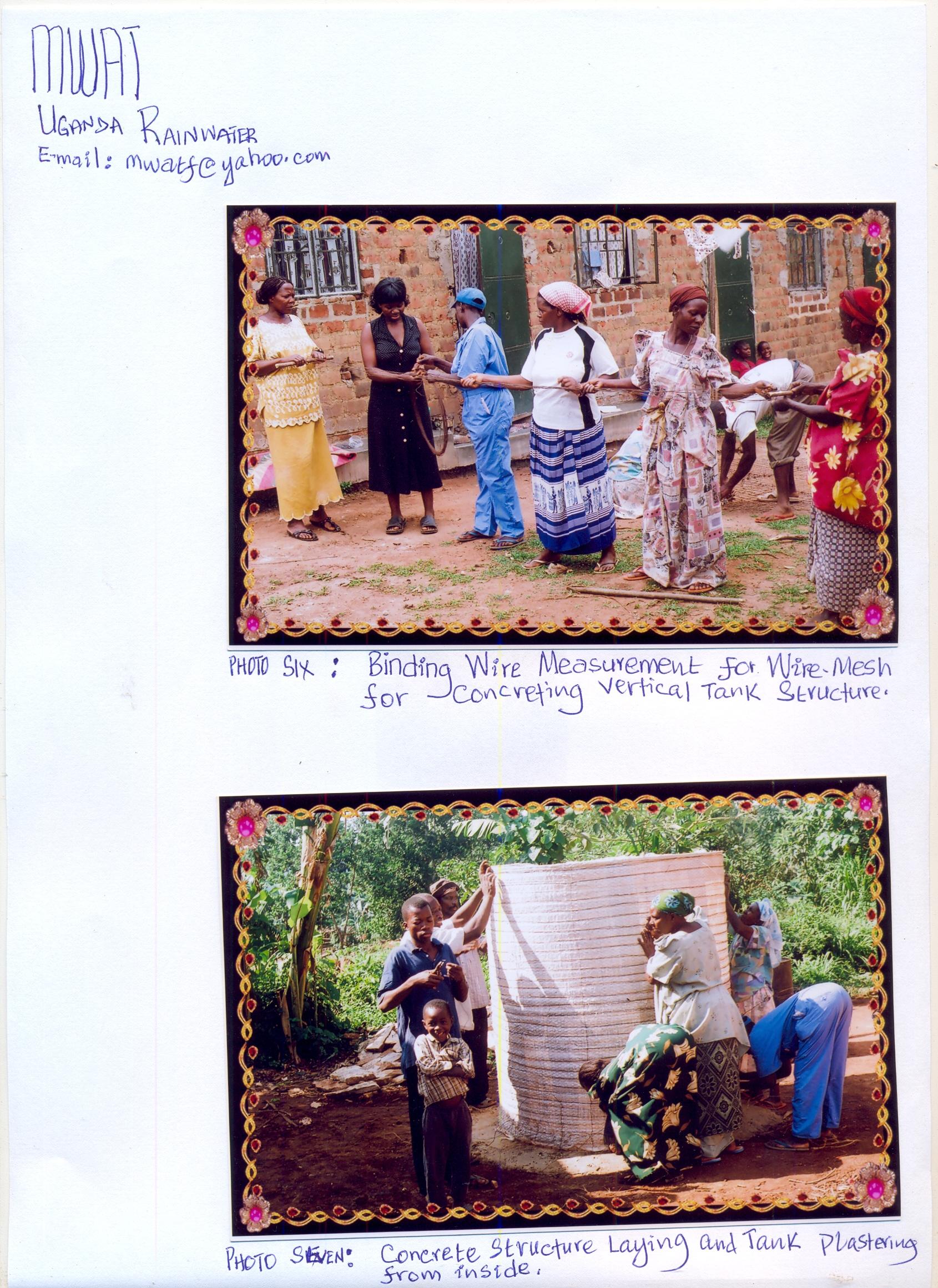
• Ferro-Cement Tanks construction
5. Key players in the project implementation were;
(i) MWATF Staff
(ii) MWATF members and partners
(iii) Elderly
(iv) P.L.W.H.A (Persons Living with HIV/AIDS)
(v) Beneficiary Homeowners
(vi) Local Elected and Civic Leaders
6. Technologies implemented were:
(i) (a) Ferro-Cement Rain Water Harvest Tank
(b) Potable Water Testing Kits
(c) Solar Water Pasteurization Technology
(ii) (a) Ferro-cement Tanks units are themselves Self-Sustaining since water costs
nominally whenever it is collected, at least Uganda shillings (UGX) 200 per 20 litres Jerricans.
(b) Potable Water Testing Kits are not easy to assess because stocks have to be with MWATF for distribution; users are expected to defry costs.
(c) Solar Water Pasteurization Technology is new and stock is not there, this presently limits its effectiveness Assessments.
(d) Solar Cookers have never been in MWATF s stock.-was never funded for training.
7 Monitoring and Evaluation Strategy.
Three Levels of Management used are s follows:
(i) MWATF management on Top
(ii) Below MWATF area Coordinators on the ground in the communities by ways of Lead Agencies (CBOs, NGOs, Groups, Associations and Households) whose task is to run a Local Water Committees (LWCs) which is answerable to MWATF.
(iii) Community stakeholders / users
8. Success Evaluation
(a) Seed Grants were received by MWATF
(b) Technical Expertise were given by Peer Water expert, Mariah Klingsmith, and Alec Desmore from USA, then jeal Ester Amati from GROOTS Kenya.
(c) Trainings by MWATF
(d) Trainer Team now in place
(e) Tanks are in place
(f) Communities informed, knowledgeable about the technologies
(g) MWATF Water Programmes now on track, exemplary in Uganda
(h) Many doors of opportunities now open for MWATF sustainable development.
9(a) Further serious plan is to construct 800 Ferro-Cement Tanks each 10,000 litres capacity each costs UGX 2,500,000 x 800 = UGX 2,000,000,000
(b) Bio-Sand Water Filter needed 300 units each cost $US 75 x 300
= US$ 22,500 (UGX: 45,450,000)
(c) Potable Water Testing Kit procurement, distribution and training costs
US$ 148,515 (UGX: 300,000,000)
(d) Solar Cookers Training and Distribution: needs 600 solar cookers each costs
UGX 500,000 x 600 = UGX 300,000,000 (US$ 148,515)
Materials costs all UGX 3,245,450,000
US$ 1,606,658
Capacity Building: UGX 202,000,000
US$ 100,000
Administrative Costs: UGX 1,522,140,000
US$ 753,535
GRAND TOTAL (3 years) UGX 4,969,601,880
US$ 2,460,198
10. Challenges encountered while implementing the projects
(i) Working and operational Capital is limited
(ii) Trainings deserve to be Residential since participants come from far away with no Transport Refunds Package
(iii) MWATF needs own Vehicles for Transport than using Public means or Hiring which are so Expensive.
(iv) Social Resistance, unpreparedness and other Barriers
(v) Exchange Rates Fluctuations makes Local Currencies got to be smaller than planned while Prices of Goods go up.
(vi) Trainer’s Honoraria so minimal compared to Inputs they give.
(vii) Site selection difficult since so many are in need but Resources so few.
(viii) There is need for more Natural Water Sources like Spring Wells, obtained freely as these technologies need Money the Poor are not able to afford.
11. MWATF used Innovative Approaches to solve these including Volunteering, giving Meals out of all Funds, plus Meeting Contingency costs than originally planned, for example, MWATF used own Resources to Facilitate Trainers.


-
 scan0001...
-
 scan0002...
-
 scan0003...
-
 scan0004...
-
 scan0005...